Apple’s position in UK business has never been stronger, and 2026 looks set to extend that
lead rather than consolidate it. Three forces are converging.
First, Apple’s share of the UK desktop estate has quietly climbed to its highest level on
record. As of April 2026, StatCounter has macOS and OS X combined at 23.4% of the UK
desktop market, against Windows on 57.3%. On the phone side, Apple holds somewhere
between 45% and 50% of the UK smartphone market depending on the source, effectively
a duopoly with Samsung.
Second, the end of Windows 10 support on 14 October 2025 has forced what Omdia calls
the long-tail SMB refresh of 2026. Around five million UK users were still on Windows 10 at
the deadline, and a meaningful slice of that fleet is now being evaluated as either a
Windows 11 upgrade, an Extended Security Updates (ESU) bridge, or a platform switch.
Third, Apple Intelligence is now fully localised for British English and runs on-device on
every M-series Mac, iPad with M-series silicon, and recent iPhone Pro models. For UK
businesses weighing AI productivity against the privacy and governance overhead of
cloud-based assistants, that changes the conversation materially.
The headline numbers that follow tell a single story: Mac and iPhone have moved from the
creative-industry fringe to a credible default in UK organisations of every size (and the
economics increasingly favour Apple even before factoring in employee preference.
1. The numbers: Apple’s UK footprint in 2026
The clearest picture of where Apple actually sits in the UK comes from StatCounter, which
tracks over 3 billion monthly page views worldwide. For April 2026, UK desktop market
share looked like this:
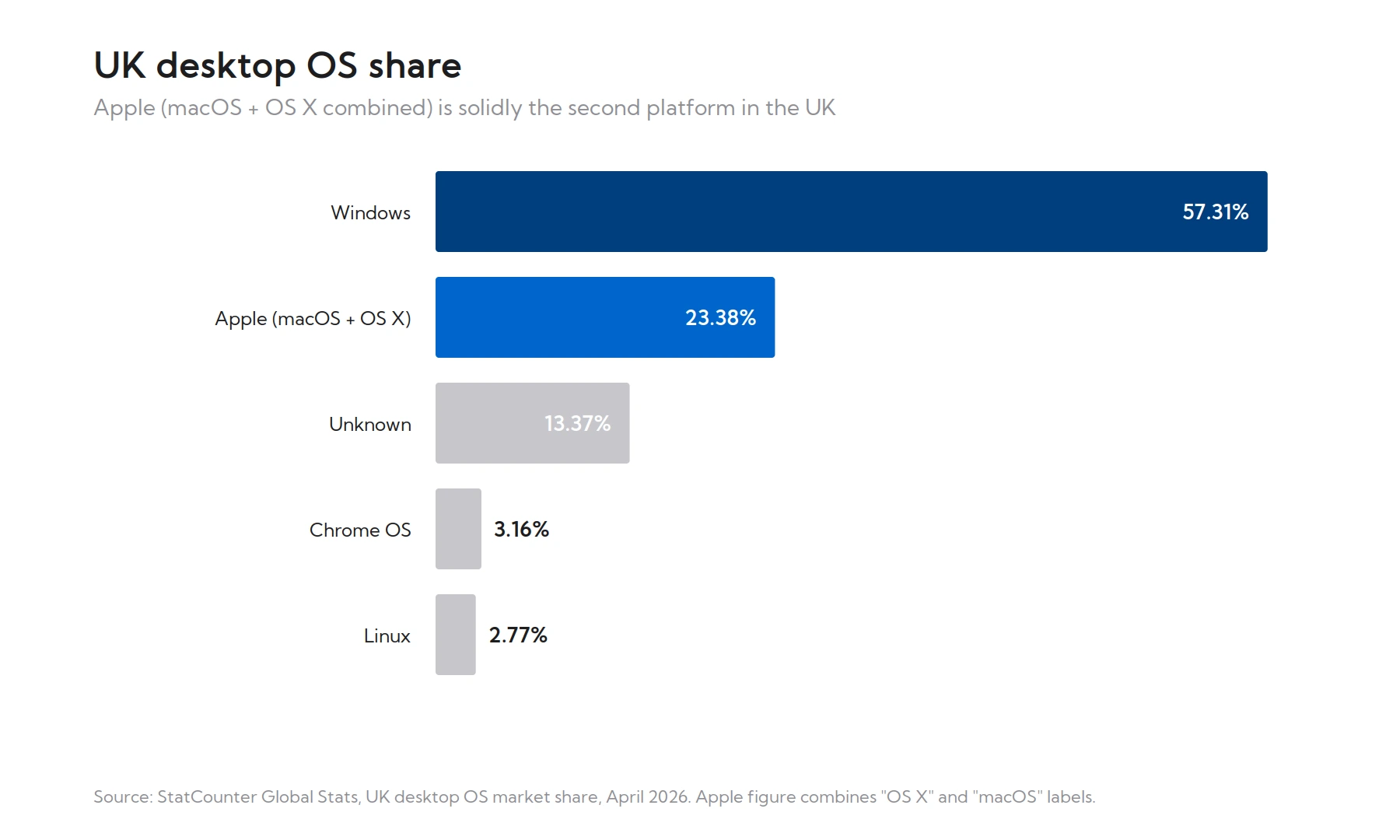
UK desktop OS share, April 2026. Apple’s combined macOS + OS X share now sits at 23.4%,
comfortably the second platform. Source: StatCounter Global Stats.
A note on the “OS X” / “macOS” split: StatCounter still reports older releases under the
legacy “OS X” label and newer releases under “macOS”. Combined, Apple’s share of the UK
desktop market sits at approximately 23.4%, comfortably the second platform, and several
points higher than the European average. The site also flags that Apple’s anti-fingerprinting changes in Safari have led to some misreporting of iOS versions, so the picture for macOS is
likely a slight understatement rather than the reverse.
For context, the global picture is very different: Windows holds around 70% of the desktop
market worldwide, with macOS in the 5–8% range depending on which StatCounter slice
you read. The UK is one of Apple’s strongest computing markets globally, sitting behind
only the US and ahead of Canada among English-speaking nations. UK customers account
for roughly 8.75% of all macOS-using organisations tracked by enterprise data provider
6sense, second only to the US.
The mobile picture is more dramatic still. The UK smartphone market is, as Oxford
economist Tejvan Pettinger noted in January 2026, a textbook duopoly: Apple and Samsung
between them control around 80% of unit share, with Apple sitting at just under 50%
depending on which tracker you use. Worldpopulationreview’s 2026 data has the UK split at
52.28% iPhone / 47.16% Android; other trackers put Apple between 45% and 49%. Either
way, Apple has been the largest UK mobile vendor since 2014 and has held the top spot
uncontested for over a decade.
What’s significant for business leaders is that the iPhone is now genuinely the default work
phone in the UK. iOS share in the UK is roughly twice what it is in Germany (around 39%)
and considerably ahead of France (35%). That density matters: it shapes which apps
developers prioritise, which MDM platforms get tested most thoroughly, and what
employees expect their employer to give them.
2. The Enterprise Tide: Mac in Business
The data that ought to most concern Windows-only IT shops in the UK comes from across
the Atlantic, but its implications are global. Omdia/Informa’s full-year 2025 US PC data,
published in April 2026, found that Apple took an 11% share of the US enterprise market –
up 2.4 percentage points from 2024. Mac growth ran at 11.2% in 2025 against an industry
average of 3.3%, with Apple’s overall annual market share across all segments hitting 16%.
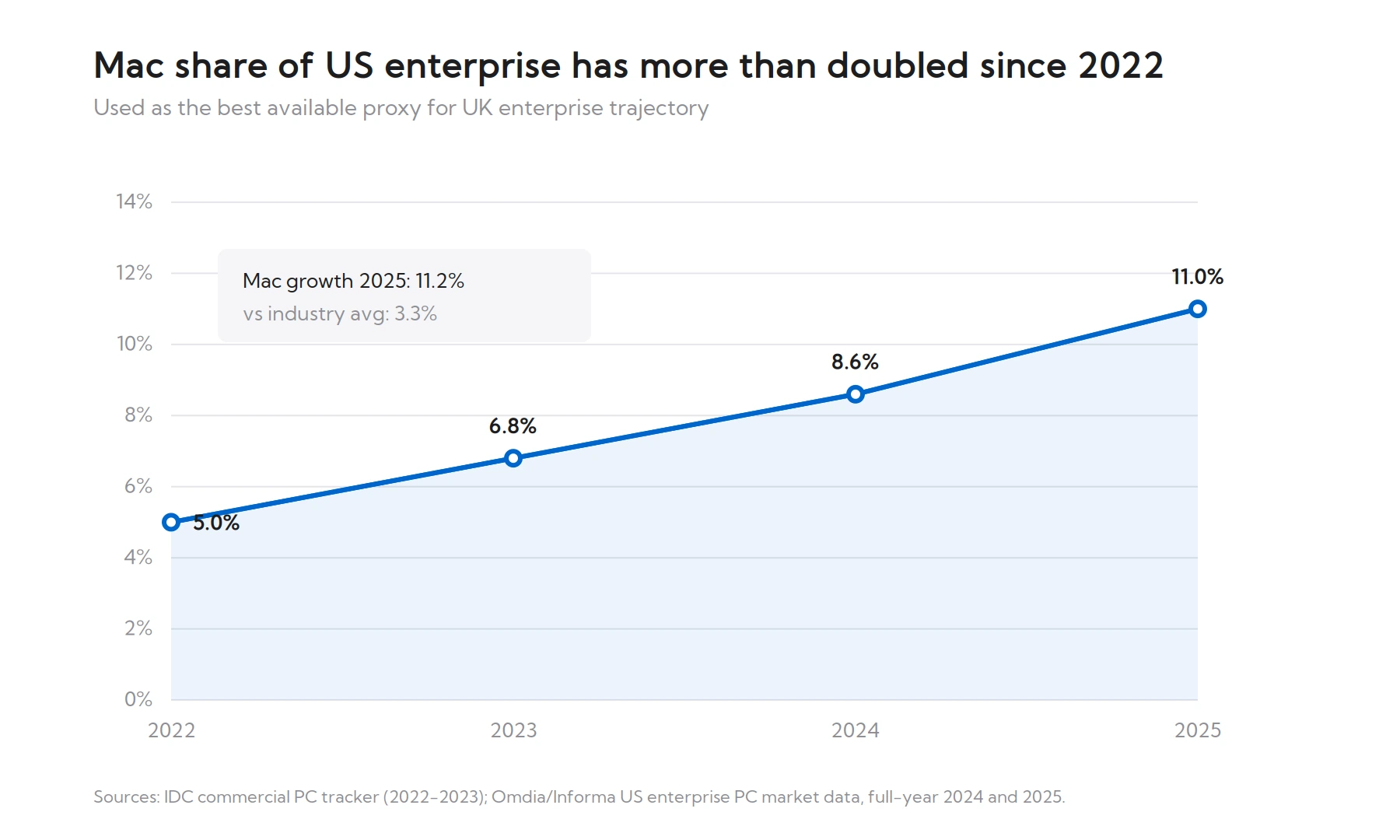
Apple’s share of the US enterprise PC market, 2022–2025. Used as the closest available
proxy for the UK trajectory. Sources: IDC commercial PC tracker; Omdia/Informa US
enterprise PC market data.
That’s not a one-off spike. IDC and Omdia have both tracked a steady climb in Apple’s
commercial PC share since the launch of Apple Silicon in 2020, with the period 2022–2025
representing what IDC has called “some of the biggest shifts in commercial PC history”. The
Mac has more than doubled its US enterprise share in three years, going from around 5% in
2022 to 11% in 2025.
UK-specific enterprise share data isn’t published as consistently, but every leading indicator – desktop OS share in business-heavy postcodes, MDM enrolment growth at the major UK Apple-focused MSPs, and Apple’s own investment in the UK Apple Partner Network – points to a parallel curve.
Three numbers from Apple’s own enterprise marketing are worth keeping in mind, all from
independently commissioned research:
● 100% of Fortune 500 companies now use Apple products in some capacity.
● 72% of employees choose Mac when their employer offers a device choice
programme (Jamf/Vanson Bourne).
● 89% of employees say they’d take a pay cut to use their preferred device (and 79%
of Mac users say they couldn’t do their job as effectively without one).
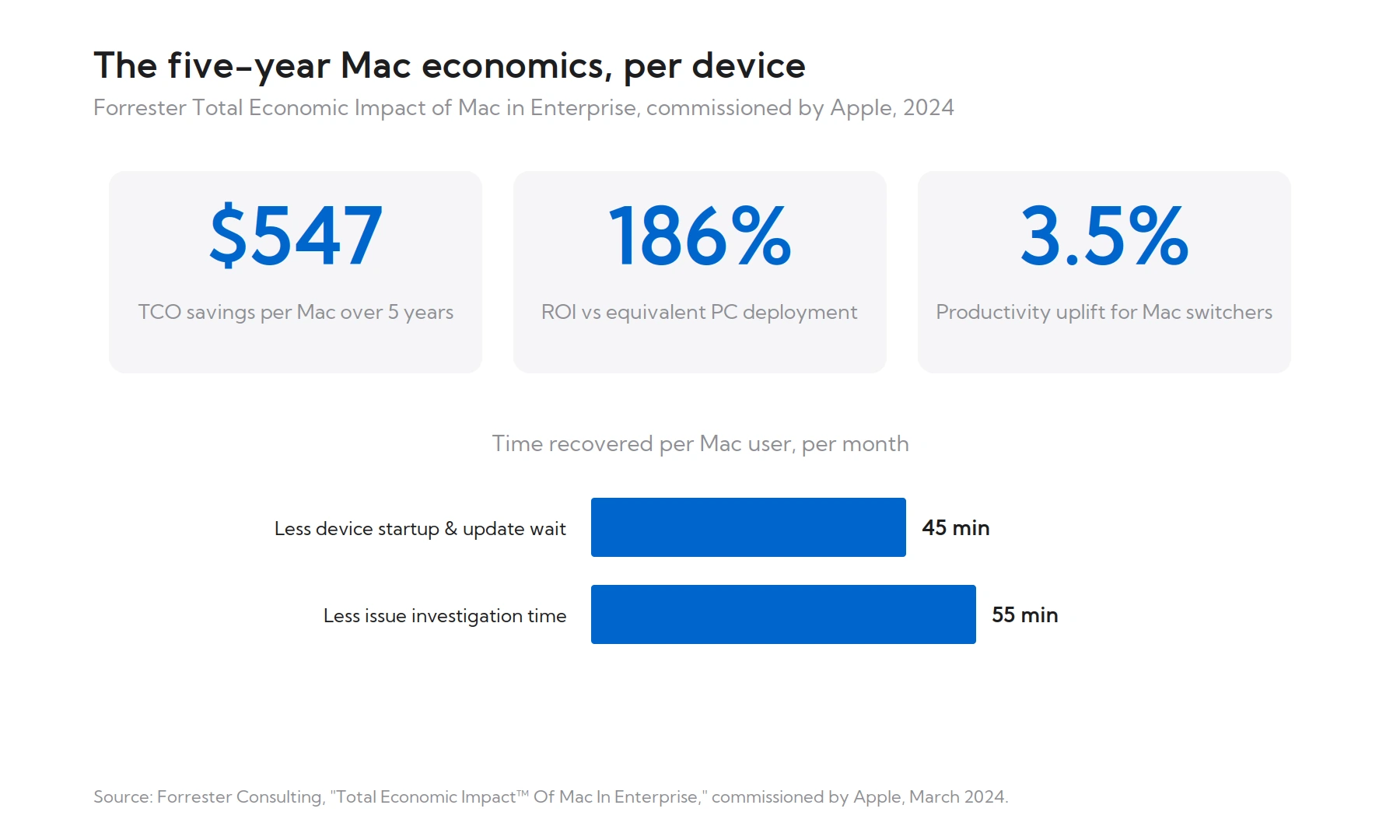
The economics back up the preference data. Forrester’s 2024 Total Economic Impact study
of Mac in enterprise, commissioned by Apple but methodologically rigorous, found that the
headline cost difference between Mac and PC reverses comprehensively over a five-year
deployment.
The five-year Mac economics, per device. Source: Forrester Consulting, “Total Economic
Impact™ Of Mac In Enterprise,” commissioned by Apple, March 2024.
Earlier IBM data, frequently cited by Apple’s enterprise team and never seriously disputed,
found that only 5% of Mac users at IBM called the help desk versus 40% of PC users, and
that Mac-using employees were 17% less likely to leave the company. Forrester’s own data
on staff retention found a 20% improvement after switching to Mac.
Some of these figures come from Apple-sponsored research, and they deserve appropriate
scepticism on that basis. But the convergence across IBM’s internal data, Jamf’s customer
telemetry, IDC’s market tracking and Forrester’s TEI methodology is striking. The story they
tell is the same one: Macs cost more up front, retain their value better, generate fewer
support calls, and keep employees in their seats for longer.
3. The Windows 10 inflection point
Every conversation about Apple in UK business in 2026 happens against a single backdrop:
Microsoft ended general support for Windows 10 on 14 October 2025, after exactly ten
years in service.
The scale of what that means for the UK is hard to overstate. A Which? survey, reported in
The Guardian in late 2025, found that around 5 million UK computer users were still running
Windows 10 at the deadline, with roughly 1 in 4 saying they planned to keep using it
regardless. Microsoft’s Extended Security Updates (ESU) programme provides a paid bridge
(at $61 per device for year one, doubling to $122 for year two and $244 for year three) but
Omdia is explicit that ESU is “a bridge solution for planned migration rather than a
long-term alternative”.
Omdia’s October 2025 analysis is the most useful piece of intelligence on what happens
next. Their take, drawing on partner channel data:
● About two-thirds of enterprises would complete Windows 11 migration by the
October 2025 deadline.
● 18% of channel partners reported customers planning to continue on Windows 10
without a defined migration path.
● 29% expected upgrades within six months or longer.
● 2026 will be the year of the SMB refresh: and SMBs make up 97% of the UK
business population (Department for Business and Trade Business Population
Estimates 2025).
This matters for Apple for two reasons. First, every forced fleet refresh is also a forced fleet
evaluation. Organisations that have run Windows because they’ve always run Windows are,
for the first time in many years, opening the question. Second, the hardware barrier is real:
Microsoft has been clear that machines purchased before 2017 are unlikely to be Windows
11-compatible without TPM 2.0 and Secure Boot. The cost of replacing those devices makes
Mac pricing far more competitive at the point of purchase than it has ever appeared on a
sticker comparison.
There’s a global e-waste dimension too: Omdia estimates as many as 240 million PCs
worldwide could need replacement if their owners can’t or won’t take the Windows 11 path.
UK businesses pursuing net-zero commitments have a sharper-than-usual incentive to
consider Apple, whose devices retain residual value better and whose 2030 emissions target
is already over 60% met.
The headline question for UK leadership teams in 2026 is no longer “should we let some
employees use Mac?” It is: “given we’re refreshing the fleet anyway, what should the next
five years look like?”
4. The Apple Silicon dividend
The reason this conversation feels different from previous Apple-in-enterprise waves is
silicon. The transition from Intel to Apple’s own M-series chips, which began in November
2020 with the M1 and is now well into the M4 generation with M5 expected later in 2026, has
done something genuinely unusual: it has made the laptop choice a performance choice
rather than a preference one.
Three numbers matter:
● MacBook Air on M4 silicon now delivers 30+ hours of video playback on a single
charge and operates fanless under typical office workloads.
● Apple’s A19 chip in the iPhone 17 line delivers up to 40% better sustained
performance than the A18 (a generational uplift in line with what M-series brings to
Mac.)
● In Computerworld’s tracking, MacBook shipments grew double-digits in multiple
2025 quarters while the overall PC market grew low single-digits.
The strategic implication for IT buyers is that the Mac is no longer the “creative team’s
machine” sitting awkwardly alongside the standard issue laptop. It is the standard issue
laptop, often outperforming the Windows-on-x86 alternative at every price point above
the budget tier and increasingly competitive even at the entry level. The Omdia forecast for
component pricing makes this even sharper: memory and storage costs rose 40–70% during
2025 and another 60% jump is expected in early 2026. Those increases hit sub-$500
Windows laptops first and hardest. The MacBook Air, which has held its UK price at around
£999 for the M-series generation, looks more competitive every quarter.
5. Security, compliance and the threat landscape
The UK Cyber Security Breaches Survey 2025/2026, published by the Department for
Science, Innovation and Technology in late April 2026, is the definitive picture of what UK
businesses are actually facing. The headline numbers:
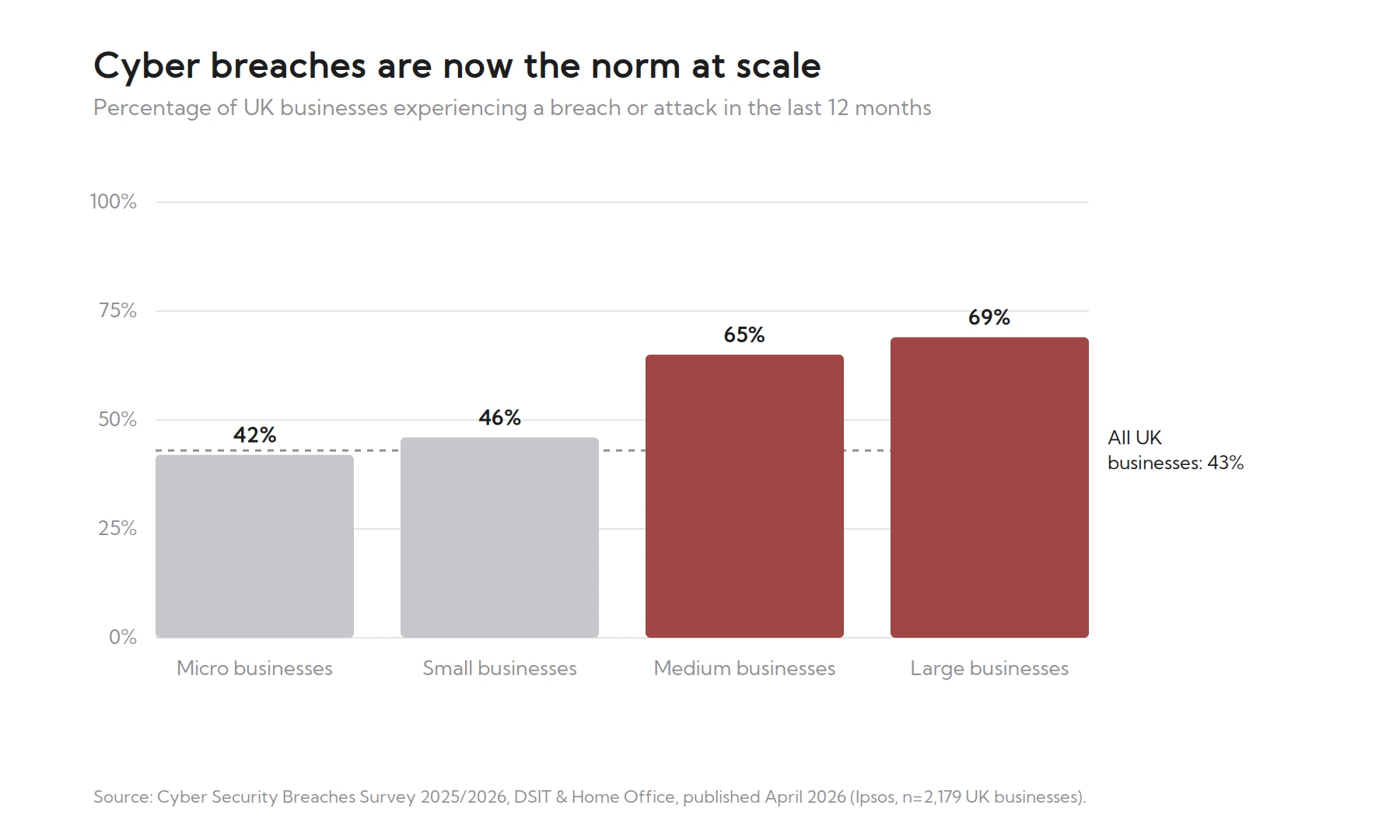
● 43% of UK businesses experienced a cyber security breach or attack in the last 12
months. That’s approximately 612,000 businesses.
● 65% of medium businesses and 69% of large businesses experienced one, meaning
at scale, breaches are now the norm rather than the exception.
● Phishing remained the most common vector, hitting 38% of businesses and judged
the most disruptive by 69% of affected organisations.
● Loss of revenue or share value as a result of a breach rose from 2% to 5%
year-on-year. Reputational damage rose from 1% to 3%.
● Average cost of cyber crime (excluding phishing): £990 per business, rising to £1,970
when zero-cost responses are excluded. Cyber-facilitated fraud averaged £5,900,
rising to £10,000.
Cyber breach prevalence by UK business size, 2025/2026. At scale, breaches are now the
norm. Source: Cyber Security Breaches Survey 2025/2026, DSIT & Home Office (Ipsos,
n=2,179 UK businesses).
The Marks & Spencer attack of April 2025, which originated through a third-party supplier
and is estimated to have cost the company around £300 million, became the cautionary tale
of the year. NCC Group’s analysis of the 2025/2026 survey put it plainly: “resilience can no
longer stop at the edge of the business”.
Where does Apple fit into this? Three structural advantages stand out, none of them silver
bullets:
- Smaller attack surface. Phishing – by far the dominant UK threat – is
platform-agnostic, but ransomware, viruses and supply-chain malware disproportionately
target Windows. Forrester’s TEI study found that organisations switching to Mac reduced their risk of a data breach by up to 90% in scenarios modelled across multiple industries.
That number sounds aggressive, but the underlying logic is straightforward: there are
simply more Windows-targeted exploits in active circulation, and macOS’s signing,
sandboxing and Gatekeeper architecture catch a meaningful proportion of what does land. - GDPR-aligned by default. Apple’s privacy architecture (on-device processing, Private
Cloud Compute, default encryption) maps unusually cleanly onto GDPR and the UK Data
Protection Act 2018. For UK organisations handling personal data, that reduces both the
engineering effort needed for compliance and the residual risk of a regulatory finding. - Mature management ecosystem. Apple Business (formerly Apple Business Manager)
combined with MDM platforms like Jamf, Kandji, Mosyle and Microsoft Intune has matured
to the point that Apple deployments scale to the hundreds of thousands of devices.
Zero-touch enrolment now genuinely works: customer reports cited by Jamf show up to an
80% reduction in provisioning time versus Windows equivalents.
The flip side, which deserves equal billing: only 27% of UK businesses now have a board
member responsible for cyber security, down from 38% in 2021. Apple’s platform
advantages don’t compensate for governance gaps. And while macOS is harder to
compromise than Windows in absolute terms, infostealers and supply-chain attacks
targeting Mac users have grown in volume through 2025.
Ever get the feeling your IT is holding you back?
Whether you’re looking to make your existing systems more efficient or are toying with the idea of a complete overhaul, Dr Logic is here to help.
6. Apple Intelligence and the AI question
Apple’s branded suite of generative AI features, Apple Intelligence, became available with
localised British English in December 2024 as part of iOS 18.2, iPadOS 18.2 and macOS
Sequoia 15.2. By the iOS 26 / macOS Tahoe 26 cycle in September 2025, the full set of
features was live in the UK: Writing Tools across Mail, Notes and Pages; Genmoji and Image
Playground; Clean Up in Photos; visual intelligence via the iPhone camera; Live Translation
in Messages, Phone and FaceTime; and Workout Buddy on Apple Watch.
For UK businesses, two things distinguish Apple Intelligence from the Windows-side AI story
(Copilot+, OpenAI integration through Microsoft 365):
On-device by default, Private Cloud Compute when not. Most Apple Intelligence
operations run locally on the device’s Neural Engine. Anything that needs more compute is
routed through Private Cloud Compute, Apple’s stateless processing layer that doesn’t
retain user data after the request completes. Independent security researchers have been
able to verify these claims (a degree of transparency unusual in the AI industry.)
Hardware-bounded availability, which is becoming an asset. Apple Intelligence requires an
iPhone 15 Pro, iPhone 16 or later, an iPad with A17 Pro or M-series silicon, or a Mac with M1 or
later. That’s restrictive, but it also means every supported device has the local NPU capacity
to run inference on-device, with the privacy guarantees that brings. Compare to the
Windows side, where Copilot+ PC requirements (NPU with 40+ TOPS) only became
standard in late 2024.
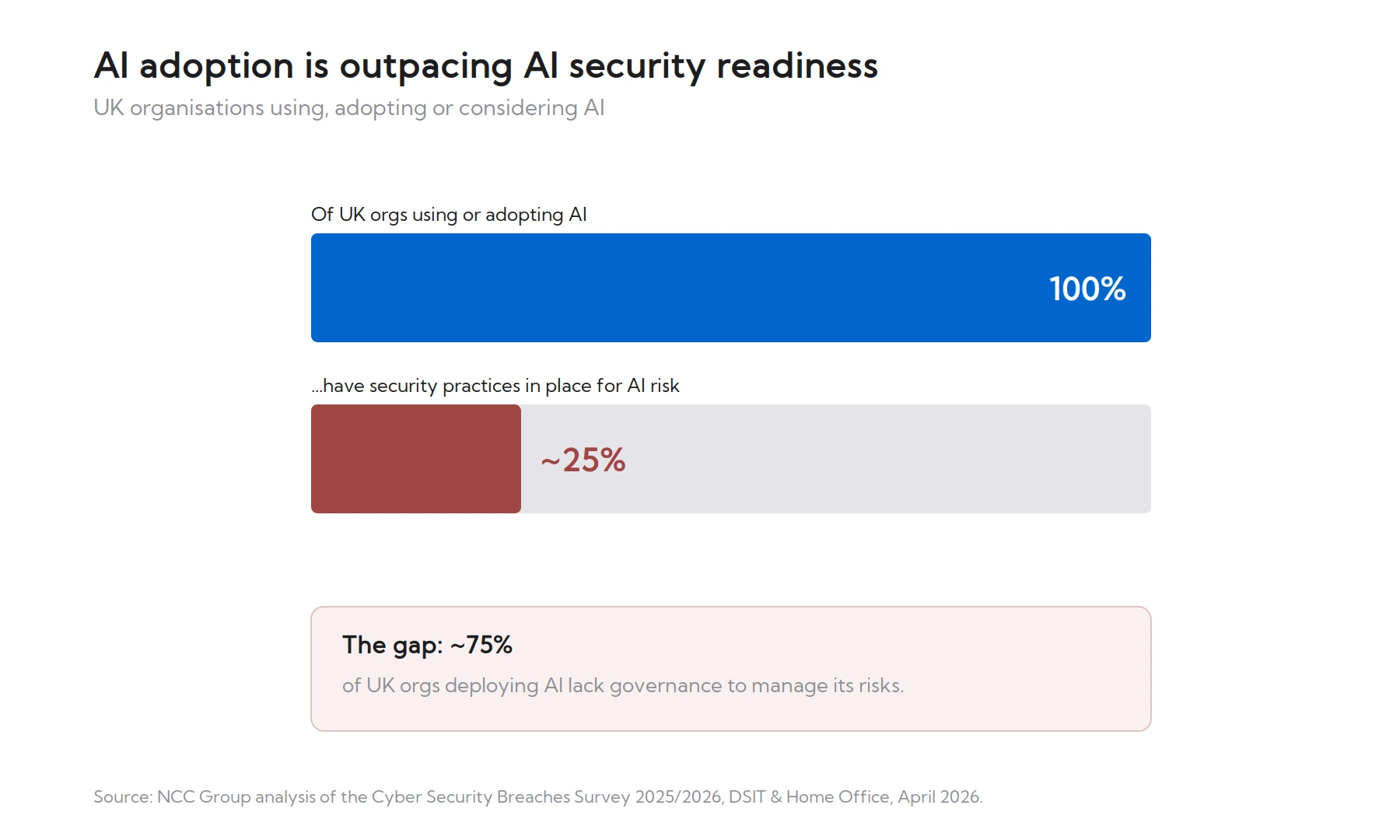
The gap between AI adoption and AI security readiness in UK organisations. Source: NCC
Group analysis of the Cyber Security Breaches Survey 2025/2026, DSIT & Home Office.
The NCC Group’s analysis of the 2025/2026 UK Cyber Survey raised an important caveat
that cuts both ways: only around a quarter of UK organisations using, adopting or
considering AI report having security practices in place to manage the risks. AI adoption is
outpacing AI security readiness across the board. Apple’s privacy-led design helps, but it
doesn’t substitute for governance (usage policies, prompt-injection awareness, output
review, data-classification rules for what employees can paste into any AI tool, Apple or
otherwise).
For organisations evaluating AI at the device fleet level, the practical question for 2026 is
whether Apple Intelligence on existing Macs and iPhones – running locally, free of additional
licence cost – covers enough of the productivity ground that a separate Copilot or ChatGPT
Enterprise subscription becomes optional rather than necessary. For many UK SMBs, that
calculation increasingly favours the Apple platform.
7. What it means for UK businesses in 2026
Three scenarios are playing out across UK organisations right now, and most teams will
recognise themselves in one of them.
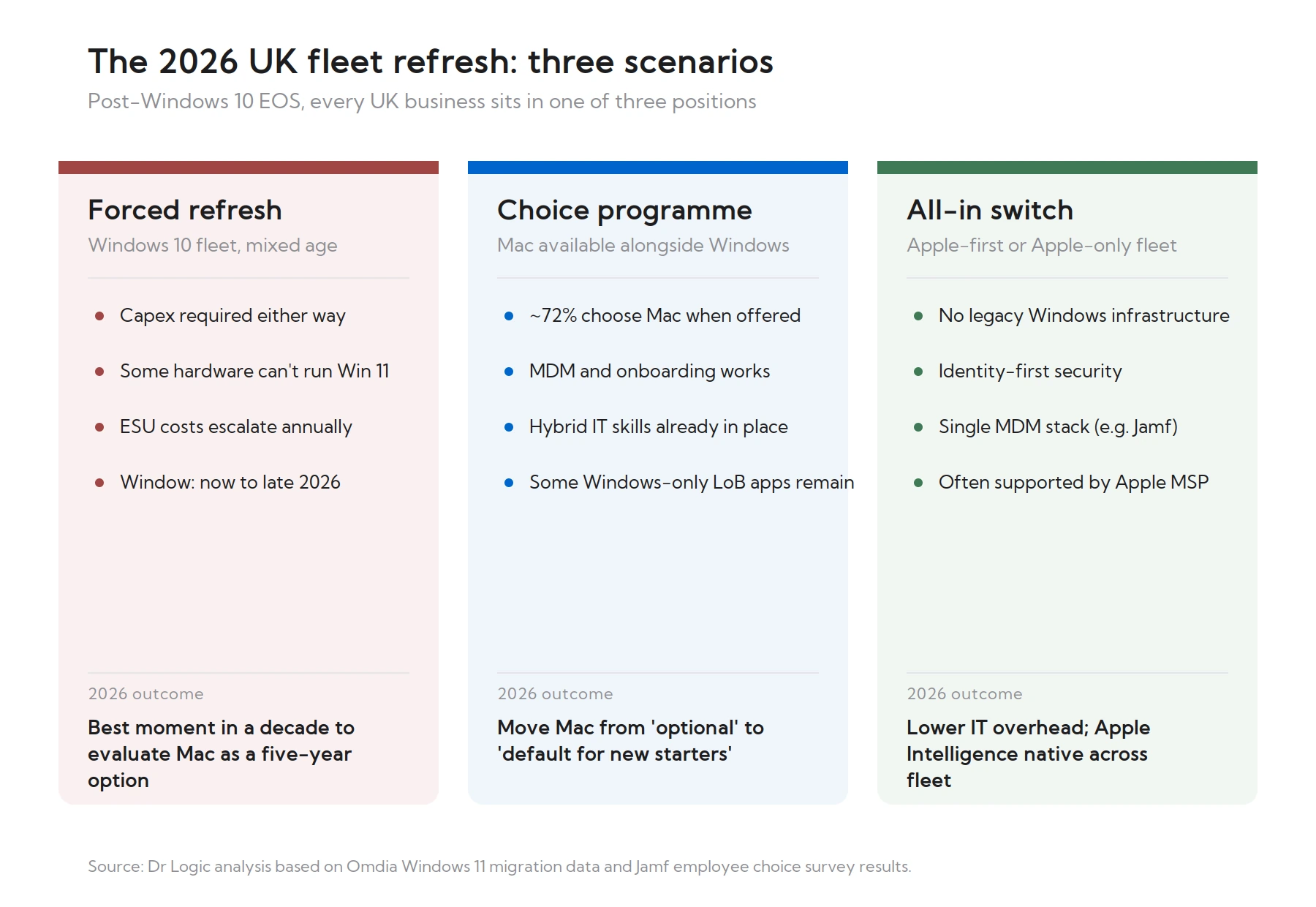
Three scenarios most UK businesses now sit within, post the Windows 10 end-of-support
deadline.
Scenario one: the forced refresh. The Windows 10 deadline has passed; ESU is buying
twelve to thirty-six months of breathing room at escalating cost. The fleet is mixed-age and
partially incompatible with Windows 11. The next eighteen months will require capital spend
either way. For organisations in this position, the question worth asking is whether a
like-for-like Windows 11 refresh is actually the cheapest five-year option, or whether a
phased move to Mac for new starters and refresh-eligible employees is more sensible than
it sounded in 2023.
Scenario two: the choice programme adopters. A growing slice of UK mid-market
organisations (particularly in professional services, technology, creative industries and
financial services) have introduced employee device choice schemes. Jamf’s data suggests
72% of employees choose Mac when offered. The operational question for these
organisations in 2026 is whether to formalise that pattern: move Mac from “optional” to
“default for new starters”, which simplifies procurement, MDM tooling and IT training
without forcing change on existing Windows users.
Scenario three: the all-in switchers. A smaller but growing number of UK SMEs and
scale-ups are running Apple-only fleets, often supported by an Apple-specialist MSP rather
than a general IT provider. The economics here are striking: a single Apple Business + Jamf or
Kandji stack, no Active Directory, no on-premise file server, no antivirus stack of the old
kind. For companies starting from scratch (or replacing legacy infrastructure during a
refresh) this can shave a meaningful percentage off total IT spend, with security and
productivity gains on top.
A few things worth watching for the remainder of 2026:
● M5 Mac launches are expected later in the year and will reset the performance
ceiling again, particularly for AI-heavy workloads on-device.
● iPhone Air and iPhone 18 updates will likely make Apple’s mid-tier business phone
offering more competitive on price.
● The UK Cyber Security and Resilience Bill, currently progressing through
Parliament, will sharpen compliance requirements for medium-and-large UK
businesses and their supply chains, making platform security architecture even
more material to board-level technology decisions.
● EU Digital Markets Act compliance continues to shape Apple’s platform openness in
ways that affect UK businesses operating across both jurisdictions, particularly
around alternative app distribution and default app selection.
The macro picture is the simplest part. Apple’s UK position is the strongest it’s ever been;
the platform’s economics have caught up with its employee-experience advantage; and the
Windows 10 cliff edge has handed UK businesses a one-time opportunity to reset their
device strategy without disrupting anything that wasn’t already going to need disrupting.
A Dr Logic Perspective:
The conversations we’re having with UK clients in 2026 aren’t about whether Apple can run a business. That question is settled. They’re about how quickly to move, how to phase the change without losing institutional muscle memory, and how to bring an existing IT function along with that shift. The single biggest mistake we see is treating a Windows-to-Mac transition as a like-for-like swap. The bigger opportunity is rethinking the whole stack: Apple Business, modern MDM (be it the Apple DMS or a third party), identity-first security, on-device AI, and a managed-service model that suits a smaller, more focused in-house IT team. The numbers in this report explain why the platform shift makes sense. What they don’t show is how much operational simplicity sits behind the headline savings.
Sources and Methodology
The data in this report draws on:
● StatCounter Global Stats for desktop and mobile operating system market share
data, April 2026 snapshot, UK and worldwide.
● Omdia / Informa for US enterprise PC market share data, full-year 2025; Windows 11
migration analysis, October 2025.
● UK Cyber Security Breaches Survey 2025/2026, Department for Science,
Innovation and Technology (DSIT) and the Home Office, conducted by Ipsos,
published April 2026.
● Forrester Total Economic Impact of Mac in Enterprise, commissioned by Apple,
March 2024 (based on interviews with 11 enterprise customers and a survey of 242
hardware decision-makers.)
● Jamf / Vanson Bourne Mac in the Enterprise survey data.
● Apple Newsroom (UK) for Apple Intelligence feature availability and timing.
● 6sense, TechLila, Worldpopulationreview, SQ Magazine for supporting market data.
Where figures come from Apple-commissioned research (notably the Forrester TEI and
Jamf studies), this has been noted in context. Where UK-specific data is unavailable and US
or global data is used as a proxy, the substitution has been flagged.
This report was last updated in May 2026. Market share, AI feature availability and
regulatory positions are moving quickly; figures should be re-verified before reuse beyond
Q3 2026.
Dr Logic is a UK-based Apple Premium Technical Partner. We help organisations get the most out of Apple – from deployment and device management to
everyday support. If you’d like a hand getting Apple Business set up properly, get in touch at drlogic.com.