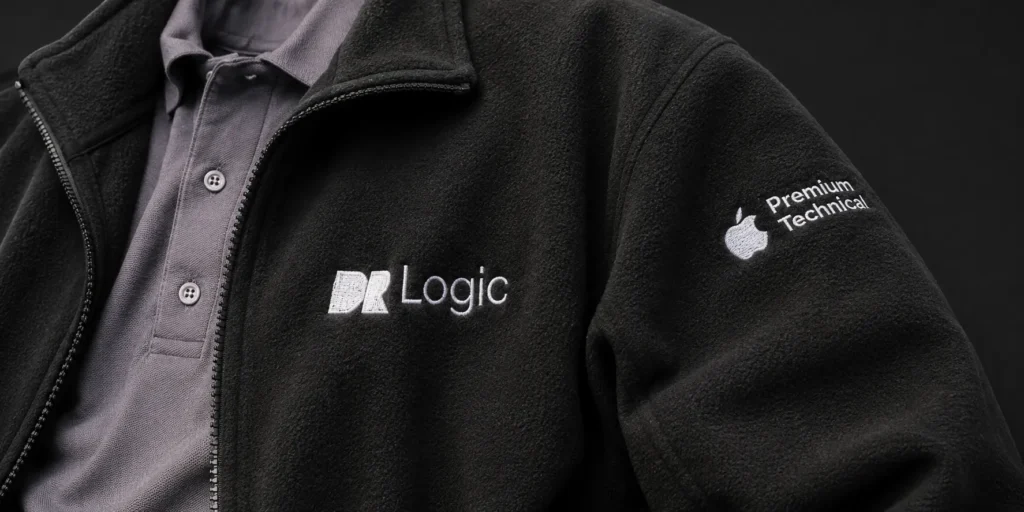
Our recent company rebrand, combined with being awarded Apple Premium Technical Partner status, gave us a natural moment to look again at something easy to overlook: our team uniform.
As we continue working towards B Corp certification, we wanted every part of the business, right down to what our people wear, to reflect our environmental and social values. So we set out to review our uniform supplier from scratch, balancing sustainability with comfort, cost and practicality for the team.
What we were looking for
A UK-based supplier was our starting point, since sourcing closer to home meant a smaller carbon footprint. From there, the list of priorities grew as we spoke to the team about what wasn’t working with our existing uniform.
We wanted garments cut for women, something we hadn’t offered consistently before, and Extra Small sizing in both male and female fits, which some of our current styles didn’t cover.
Comfort for neurodivergent employees mattered too, as did trimming down our range to avoid the kind of underused stock that just sits in storage.
Practically, we needed uniform that could be layered for colder working environments, in colours that suited the new brand while resisting fading from frequent washing.
Durability was non-negotiable: we wanted garments built to last at least two years. And, since we’d be retiring our old branded stock, we wanted to find a responsible way to dispose of it rather than sending it to landfill.
Comparing suppliers (including a B Corp one)
We approached several UK suppliers alongside Merchery, a Belgian company with B Corp certification. On paper, Merchery looked like a strong fit given our own sustainability goals, but their high minimum order quantities would have meant overordering and storing uniform we didn’t yet need. Combined with a higher cost per item, a mostly unisex range, and a larger carbon footprint from importing, the numbers didn’t add up once we weighed everything against the alternatives.
That left three UK suppliers: The Uniform Shop, Conceptwear and Kylemark. We ordered samples from all three so we could properly assess quality, sizing, colour and fit rather than relying on spec sheets alone.
Listening to the team
Sustainability and cost only get you so far if the uniform itself doesn’t work for the people wearing it. We’d already had feedback about the need for smaller sizes and female-specific cuts, so this was front of mind throughout.
In mid-May, we brought together a small group of colleagues from different parts of the business to talk through comfort and practicality, and to request samples they could actually feel and try on, not just look at.
In early June, we met with a team member who finds standard uniform difficult to wear comfortably. That conversation led directly to two changes: offering plain t-shirts without logos as an alternative to polo shirts, and sourcing jacket samples as an alternative to the fleece. It was a good reminder that inclusive design decisions often come from a single honest conversation.
Finding the right partner
As the samples came in, one supplier stood out: Conceptwear, based in Weston-super-Mare, around 60 miles from our Exeter base. Conceptwear could supply almost the entire range we needed from a single source, and made it easy to dig into the sustainability credentials of the brands behind their garments, sharing detailed information without us having to chase it down.
Through Conceptwear, we reviewed three garment brands:
Regatta offered good fleece quality with both male and female cuts, and a particularly strong size range in black.
RTX Pro had the best quality polo shirts of the three, with male and female cuts in short sleeve and a size range that suited our team well, though the long-sleeve polo is unisex only.
Kustom Kit produced a lighter-weight garment that won’t offer quite the same warmth as RTX, but still came with male and female cuts and a good size range in short-sleeve polos. As with RTX, the long-sleeve polo is unisex, and its smallest size is a Small.
What happens next
Off the back of this review, we’ve decided to introduce this new, more sustainable uniform range, and we’re continuing to explore additional options for neurodivergent employees beyond the t-shirt and jacket alternatives already agreed.
We’re also reducing how often we order to cut down on excess stock, and putting garment care and replacement guidelines in place so uniform is looked after properly and only replaced when it genuinely needs to be.
For our old branded uniform, we’re looking at responsible ways to retire it, likely through a mix of textile recycling and donation, rather than letting it go to waste, and we’ll share more detail once that plan is finalised.
Looking ahead
This review has been a useful exercise in applying our B Corp principles to a decision that might otherwise have been a simple like-for-like reorder.
Over the coming months, we’ll be checking in with the team on how the new uniform performs day to day, and we’ll share an update once we’ve seen it in use for a while, including how the garments hold up and how the disposal of our old stock has gone.
It’s a small piece of a bigger picture, but it’s exactly the kind of everyday decision our B Corp journey is asking us to look at more closely.