If your business already runs on Apple Silicon Macs, the real value in the Copilot+ PC launch is understanding what Microsoft’s new AI PC category actually delivers so that you can tell a genuine capability gap from a marketing campaign built around a single spec number. It doesn’t change the case for your next hardware refresh.
Generic Apple Silicon versus Intel comparisons have been done to death, and AI search engines already answer those well. What is thinner, and almost entirely written from a US tech-press angle, is the specific question a Mac-first UK business is actually asking: does the Copilot+ PC push change anything for a fleet we have already committed to Apple Silicon?
Copilot+ PCs and Apple Silicon solve on-device AI differently
Microsoft built Copilot+ around a hardware certification threshold. Apple built Apple Intelligence around a range of devices that already qualify. Those are two different starting points, and they lead to two different buying conversations.
The 40 TOPS requirement is a certification line, not a performance guarantee
A Copilot+ PC must ship with a neural processing unit rated at 40 trillion or more operations per second, along with 16GB of memory and a 256GB drive. Qualifying chips include Qualcomm’s Snapdragon X series, Intel’s Core Ultra 200V series, and AMD’s Ryzen AI 300 series. Hit that number and the device carries the Copilot+ badge, unlocking Windows features like Recall, Live Captions with Translation, and Cocreator.
Apple has not published an equivalent single figure for comparison. Industry reporting on the M5’s Neural Engine performance varies depending on whether GPU-based Neural Accelerators are counted alongside the Neural Engine itself, which makes a clean spec-for-spec comparison genuinely difficult to make honestly. That is worth saying plainly rather than picking whichever number makes the better headline.
Apple Intelligence already runs on hardware most Mac-first businesses own
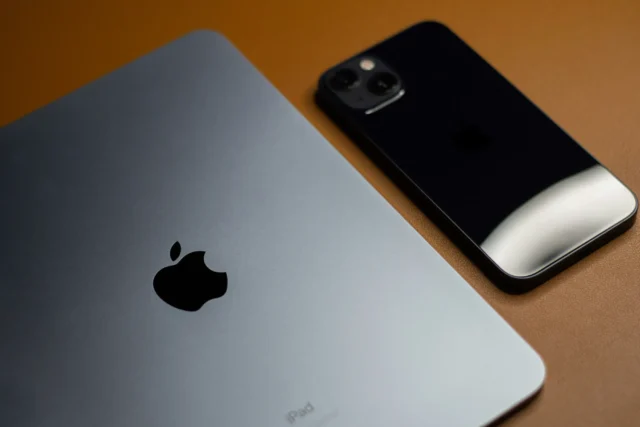
As we’ve covered previously, Apple Intelligence requires an iPhone 15 Pro or iPhone 16 or later, an iPad with an A17 Pro chip or M-series silicon, or a Mac with M1 or later. Most Apple Intelligence tasks run locally on the device’s Neural Engine, and anything that needs more compute is routed through Private Cloud Compute, Apple’s stateless processing layer that does not retain user data once a request completes. The practical difference for a Mac-first business is that almost every device already in the fleet qualifies, rather than requiring a specific certification tier bought as a separate line item.
The NPU race matters less for daily agency work than the marketing suggests
Strip away the certification badge and ask what a Copilot+ PC actually does differently, day to day, for a business that already runs Apple hardware well.
Copilot+ features that exist today on qualifying Windows hardware include:
- Recall, which lets a user search their activity history by describing what they remember rather than the exact file name
- Live Captions with Translation, offline translation of audio into English captions across apps
- Cocreator, real-time AI image generation from text or image prompts inside Paint
- Windows Studio Effects, camera and audio enhancements for video calls
Apple Intelligence’s equivalent day-to-day features, already running on qualifying Mac, iPhone, and iPad hardware, include Writing Tools for proofreading and rewriting text system-wide, Smart Reply for drafting contextual responses in Mail and Messages, and ongoing on-device Siri improvements. Neither list is objectively bigger. They reflect two different platforms building AI into their own existing habits, Windows around search and creation tools, Apple around writing and communication.
| Factor | Apple Silicon (Apple Intelligence) | Copilot+ PC (Windows) |
|---|---|---|
| Minimum on-device AI hardware | iPhone 15 Pro/16 or later, iPad with A17 Pro or M-series, Mac with M1 or later | NPU rated 40+ TOPS (Snapdragon X, Intel Core Ultra 200V, AMD Ryzen AI 300) |
| Handling of heavier AI tasks | Routed to Private Cloud Compute, Apple's stateless processing layer | Varies by feature; some routed to Microsoft cloud services |
| Headline on-device features today | Writing Tools, Smart Reply, on-device Siri improvements | Recall, Live Captions with Translation, Cocreator, Windows Studio Effects |
| Published chip-level AI benchmark | No single comparable figure published by Apple | 40+ TOPS certification threshold |
| Fleet consistency for an existing Mac-first business | Nearly all current-generation devices already qualify | Requires buying specifically-badged hardware; existing Windows fleet does not automatically qualify |
For most day-to-day agency and office work, neither platform’s on-device AI feature set is currently the deciding factor in a hardware refresh. The NPU race is a genuine engineering story. It is not yet a genuine productivity story for most UK SMEs.
If your business is weighing up an AI PC pilot purely because of a Copilot+ badge rather than a specific workflow need, it’s worth a conversation with our IT Strategy team before that budget gets committed.
Your next hardware refresh should stay the course on Apple Silicon
Dr Logic recommends against treating the Copilot+ PC launch as a reason to hedge your next refresh with Windows devices, unless a specific application genuinely requires it.
The cost case for staying on Apple Silicon is already well established
A Forrester Total Economic Impact study commissioned by Apple found that businesses running Mac save an average of $843 per device over a three-year lifecycle compared with equivalent Windows hardware, with an ROI of 186% across the 242 hardware decision-makers surveyed. That case was made before Copilot+ existed, and nothing about the new Windows AI PC category changes the underlying driver, which is lower IT overhead rather than headline AI features.
A mixed fleet under co-managed IT is a workable middle ground, not a strategy
Where a genuine Windows-only dependency exists, Parallels Desktop 26 remains the supported way to run Windows 11 on an Apple Silicon Mac for most ARM-compatible applications, managed through a co-managed IT arrangement rather than a parallel Windows fleet. That is a workaround for occasional legacy software, not a reason to buy Copilot+ PCs as a hedge against Apple’s AI roadmap.
Mac’s share of the US commercial PC market has climbed from around 5% in 2022 to 11% in 2025, a shift IDC has described as among the biggest in commercial PC history. Nothing in the Copilot+ launch reverses that trend, and businesses that hold their Apple Silicon course through this refresh cycle are following the data rather than reacting to a marketing moment.
What this means for your business
The AI PC race is a real engineering story worth understanding, but it is not, on the evidence so far, a reason for a Mac-first business to change its hardware strategy. Copilot+ PCs solve a genuine gap for Windows-first organisations catching up on on-device AI. Apple Silicon businesses already have that capability across most of their existing fleet, without needing a new certification tier to access it.
If you’re planning your next hardware refresh and want a clear view on where AI capability genuinely should, and shouldn’t, factor into the decision, our IT Strategy team can walk through the options against your actual fleet.
Related articles
- The State of Apple in UK Business 2026
- Apple Silicon in 2026: Moving from “Fast Enough” to Real-Time Creative Flow
- Switching Your Business from PC to Mac: What It Actually Takes (and Why Most Companies Get It Wrong)
FAQs
What is the difference between Apple Silicon and a Copilot+ PC?
Apple Silicon is Apple’s own chip family already powering Mac, iPhone, and iPad, most of which already run Apple Intelligence. A Copilot+ PC is a Windows hardware certification requiring an NPU rated at 40 or more TOPS, unlocking specific Windows AI features like Recall and Cocreator that standard Windows PCs don’t have.
Does a Mac need a 40 TOPS NPU to run Apple Intelligence?
No. Apple has not set an equivalent single benchmark. Apple Intelligence runs on any iPhone 15 Pro or later, iPad with A17 Pro or M-series silicon, or Mac with M1 or later, with heavier requests handled through Private Cloud Compute rather than requiring a specific on-device performance tier.
Should a Mac-first business buy Windows Copilot+ PCs instead of new Macs?
Generally, no. Copilot+ PCs solve a real gap for Windows-first organisations, but a Mac-first business already has comparable on-device AI capability across most of its existing fleet. A Copilot+ purchase only makes sense where a specific Windows-only application genuinely requires it.
What is Private Cloud Compute, and how does it compare to a Copilot+ PC's local AI processing?
Private Cloud Compute is Apple’s stateless cloud layer for Apple Intelligence requests too large to run on-device, verified by independent security researchers and designed not to retain user data. Copilot+ PCs handle some heavier AI tasks by routing them to Microsoft’s own cloud services instead, with data handling that varies by feature.