Six weeks after the MacBook Neo landed, it has genuinely changed the shape of Apple’s lineup. You can buy a new MacBook in the UK for £499. That’s not a typo, and that’s not a refurb. It’s a brand-new Mac, in a proper aluminium chassis, running full macOS.
When we first covered the Neo back in March, the question was whether Apple would really ship a sub-£600 laptop aimed at the Chromebook and budget Windows crowd. They did. Since then, reviews have landed, benchmarks have been published, and the Neo has sold well enough that Apple is reportedly running into chip supply issues trying to keep up.
So now we can answer the question the first wave of coverage couldn’t: is this thing actually good enough to hand to a member of your team and expect them to do real work on it?
The short answer is yes — for most people. The longer answer matters more, because the interesting thing about the Neo isn’t the price. It’s what Apple is clearly trying to do with it.
What Apple is actually up to with the MacBook Neo
In more than two decades of selling, supporting, and deploying Apple hardware, we can’t remember Apple doing what it’s just done. Apple’s traditional playbook is premium pricing and letting the cheap end of the market go to Dell, HP, Lenovo, and Google. The MacBook Air has been the “entry-level” Mac for so long that the phrase itself became a little ridiculous when the thing costs over a grand.
Ever get the feeling your IT is holding you back?
Whether you’re looking to make your existing systems more efficient or are toying with the idea of a complete overhaul, Dr Logic is here to help.
The Neo breaks that pattern. Starting at £499, or £583 for the 512GB model with Touch ID, it sits in a price band Apple has never seriously competed in before. And it’s not a crippled device. It’s a laptop people actually want to buy — reports out of Apple suggest demand has exceeded the initial five-to-six-million-unit plan, and waiting times for the 512GB model have already slipped by weeks.
The strategic read is straightforward. This is Apple quietly going after the one segment of the business market it has never properly reached: the everyday laptop issued to everyday staff. The back-office team. The graduate intake. The frontline and hospitality workers. The ones who, up to now, got a £450 Windows laptop because anything with an Apple on the lid was “too expensive for that role.”
That’s the thin end of the wedge. Get the Neo on someone’s desk, and the case for their next phone being an iPhone, their next tablet being an iPad, and their identity sitting inside Apple Business becomes easier to make. Apple isn’t chasing the Neo as a margin product. It’s chasing it as an ecosystem gateway. The chip shortage issue backs that up — the A18 Pro chips Apple is using in the Neo are reportedly binned-down units that would otherwise have been scrapped. It costs Apple almost nothing to produce, relatively speaking.
None of that matters if the thing isn’t usable. So let’s get to that.
Is the A18 Pro actually powerful enough for real work?
This is where the Neo’s story gets genuinely interesting. Apple has done something it has never done before in a Mac: it put an iPhone chip inside.
The A18 Pro is the same chip that powered the iPhone 16 Pro, with one GPU core disabled. On paper, that sounds like a compromise. In practice, the results are surprising.
On single-core performance — the thing that most affects how a laptop *feels* during everyday use — the A18 Pro benchmarks in roughly the same territory as the M3 and within a few percent of the M4. That covers the overwhelming majority of office work: opening apps, loading web pages, switching tabs, typing in documents, running your email client. If you put someone on a Neo and didn’t tell them which chip it had, most would assume it was a current-generation Mac.
Where the Neo shows its limits is in multi-core workloads. With only six cores (two performance, four efficiency) against the eight cores in the current M-series Airs and Pros, the Neo returns roughly half the multi-core performance of the latest MacBook Air. That matters if you’re transcoding video, compiling large codebases, running virtual machines, or pushing sustained load across multiple cores for minutes at a time.
The other hard ceiling is memory. The Neo has 8GB of unified RAM. It’s not 8GB base; it’s 8GB, full stop. You can’t configure it with more. For a user running a browser, a chat app, Microsoft 365, and a handful of cloud tools, macOS handles that surprisingly well thanks to how unified memory and compression work. For someone with fifty browser tabs, Adobe InDesign, and a local database open at the same time, it will run out of road.
Independent reviews have largely landed in the same place. TechFinitive, reviewing the Neo specifically as a business laptop, ran Pages, InDesign, Word, and Excel (including pivot tables) without hitting issues. 9to5Mac’s reviewer spent six days doing real work on one and never hit a ceiling. Tom’s Hardware noted the multi-core gap against the Air but concluded that for the tasks most people actually do on a laptop, the Neo delivers.
The fan is also worth a mention, because there isn’t one. The Neo is fanless, which means silent operation, no throttling quirks, and nothing to fail over time. It’s one of the things that genuinely makes it feel like a “real” Mac rather than a cheap facsimile.
The honest trade-offs
To hit £499, Apple has cut things. Some of them you’ll notice, some you won’t. Here’s the list, without sugar-coating:
- No backlit keyboard. Fine in an office, annoying on a train at night.
- One of the two USB-C ports runs at USB 2.0 speeds. That’s the sort of thing you haven’t read about a new Mac in fifteen years. If you plug a fast external drive into the wrong port, macOS will actually tell you to move it.
- No Thunderbolt. Rules out eGPUs, high-speed storage arrays, and most serious docking setups.
- No MagSafe. You charge via USB-C.
- Touch ID is extra. It’s only on the £583 model, not the base £499.
- The trackpad is mechanical, not haptic. Works fine; doesn’t have the Force Touch refinement of an Air or Pro.
- Wi-Fi 6E, not Wi-Fi 7. Almost no UK office has Wi-Fi 7 infrastructure yet, so this rarely bites in practice.
- 1080p webcam rather than Apple’s newer 12MP Center Stage camera. Perfectly fine for video calls.
- Eight gigabytes of RAM, forever. Not upgradeable. This is the ceiling that will age hardest.
None of these are deal-breakers for the right user. All of them together paint a clear picture of what the Neo is: a carefully costed machine aimed at people whose needs genuinely don’t stretch to Thunderbolt and 16GB of RAM.
Who the Neo is right for
Based on the specs, the reviews, and how we’d actually deploy one for a client, the Neo makes sense for:
- General office staff whose day is browser-based SaaS, email, Microsoft 365 or Google Workspace, video calls, and documents
- Retail, hospitality, and front-of-house roles where durability matters but workloads are light
- New joiners, graduates, and temporary contractors where a £1,200 MacBook Air is hard to justify
- Secondary or travel devices for senior staff who already have a more powerful machine on their desk
- Businesses piloting Mac adoption for the first time — the Neo halves the cost of finding out whether Apple actually suits your team
Who the Neo is wrong for
This is the bit that doesn’t usually get said in launch coverage, but it matters. The Neo is the wrong laptop for:
- Designers and creatives working in Adobe Creative Cloud at any scale — InDesign and Photoshop will run, but you’ll feel the 8GB ceiling quickly
- Developers running Docker, virtual machines, local AI models, or large codebases
- Data analysts routinely working with big spreadsheets, large datasets, or BI tools
- Anyone who needs Thunderbolt for external storage arrays, professional audio interfaces, or multi-monitor docking setups
- Users who regularly keep dozens of browser tabs, multiple Office apps, and a chat client open simultaneously while also running something memory-intensive in the background
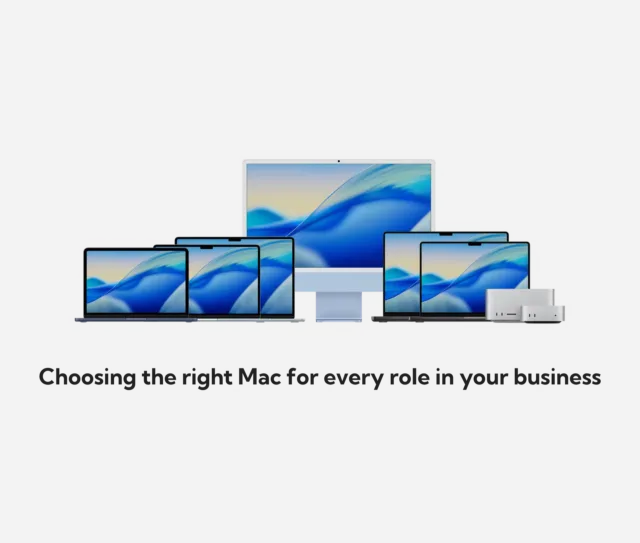
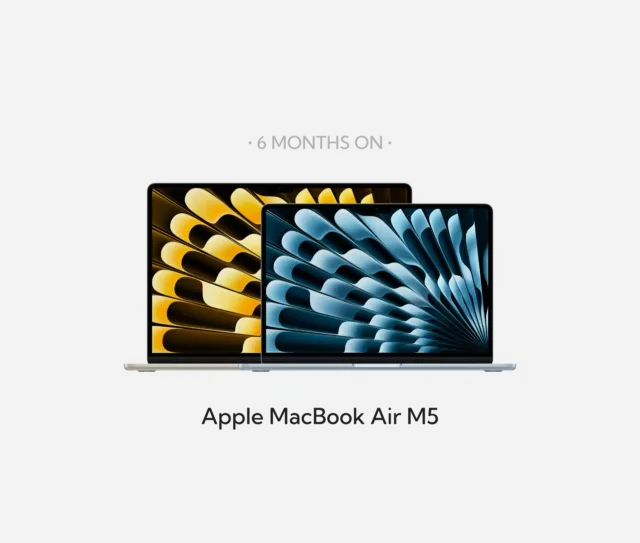
For those users, the MacBook Air M5 is still the sensible starting point, and the MacBook Pro where the workload genuinely demands it. The Neo doesn’t replace the Air. It sits underneath it and picks up a different user entirely.
What this means for your business
The most interesting thing about the Neo isn’t the Neo. It’s the conversation it forces.
Most businesses over-specify their baseline laptop because the per-unit price difference between “fine” and “great” was, until now, small enough not to argue about. A £1,200 Air felt like a safe default. The Neo changes the maths. The gap between a Neo and an Air is now roughly £700 per user. Multiply that across a team of thirty, and the question becomes unavoidable: do we actually know what each role needs, or are we handing out identical hardware because it’s easier than thinking about it?
That’s an IT strategy question, not a procurement one. The right answer is almost never “switch everyone to the cheap MacBook.” It’s usually “match the machine to the role” — which means some users genuinely do need a Pro, some are perfectly served by an Air, and some would be fine on a Neo. Getting that mix right is where the actual savings live, not in blanket downgrades.
For businesses evaluating Apple for the first time, the Neo also makes trialling a lot more realistic. A ten-person Mac pilot used to start at twelve grand. At Neo pricing, it’s roughly half that. If you’ve been curious about whether a shift to Apple would actually work for your team but couldn’t stomach the trial cost, that barrier has just moved.
Thinking about rolling MacBook Neo across your fleet? We can help you plan it.
Our take
The MacBook Neo isn’t the best Mac Apple makes. It’s arguably the most strategically interesting one it’s released in years. For a big chunk of the UK workforce, it’s genuinely enough. For others — designers, developers, anyone pushing a laptop hard — it’ll frustrate within a fortnight.
The skill, as ever, is matching the hardware to the work. That’s not a job the Neo solves on its own. It just finally gives businesses the third option the Mac lineup has been missing.
If you’re thinking about whether the Neo has a place in your business, that’s exactly the kind of question our work exists to answer: what hardware your team actually needs, what you’re currently spending versus what you should be, and where Apple fits across your wider stack. And if you’d rather focus the conversation specifically on Apple expertise, our team works with Mac-first UK businesses on this every day.
—
Related articles:
- MacBook Neo: The £599 Mac That Could Bring a New Wave of Switchers
- Give the People What They Want (Without Breaking the Bank): The Neo and the Rise of Employee Choice
- Apple Has a New CEO – Here’s What It Means for Businesses Built on Apple
- Beyond the Spec Sheet: How to Build a Mac Refresh Strategy That Saves Money and Reduces Waste
—
FAQs
Is the MacBook Neo good enough to use as a main work laptop?
For most office-based knowledge work, email, browser-based SaaS, Microsoft 365, Google Workspace, video calls, and documents, yes. The A18 Pro chip delivers single-core performance close to the M4, which is what you feel during everyday use. The Neo struggles with sustained multi-core workloads like video editing, heavy data processing, local virtual machines, or development work, so it isn’t suited to technical or creative roles. The 8GB of non-upgradeable RAM is the hardest ceiling to work around long-term.
How does the MacBook Neo compare to the MacBook Air?
The Neo sits a tier below the Air on both price and capability. The Air has a more powerful M-series chip, configurable RAM up to 24GB, Thunderbolt support, a backlit keyboard, and a haptic trackpad. The Neo is roughly half the price at £499, offers comparable single-core speed for everyday tasks, but caps at 8GB of memory and loses Thunderbolt. The Air remains the better all-round laptop; the Neo is the better value for general business users who don’t push their hardware.
Can businesses manage the MacBook Neo alongside other Macs?
Yes. The Neo runs full macOS and supports the same mobile device management, zero-touch deployment, and security tooling as any other Mac, including Apple Business Manager and third-party MDM platforms like Jamf, Kandji, Intune and Addigy. From an IT management perspective it behaves identically to an Air or Pro, all the differences are at the hardware level, not the software or management layer.