Updated: September 2026
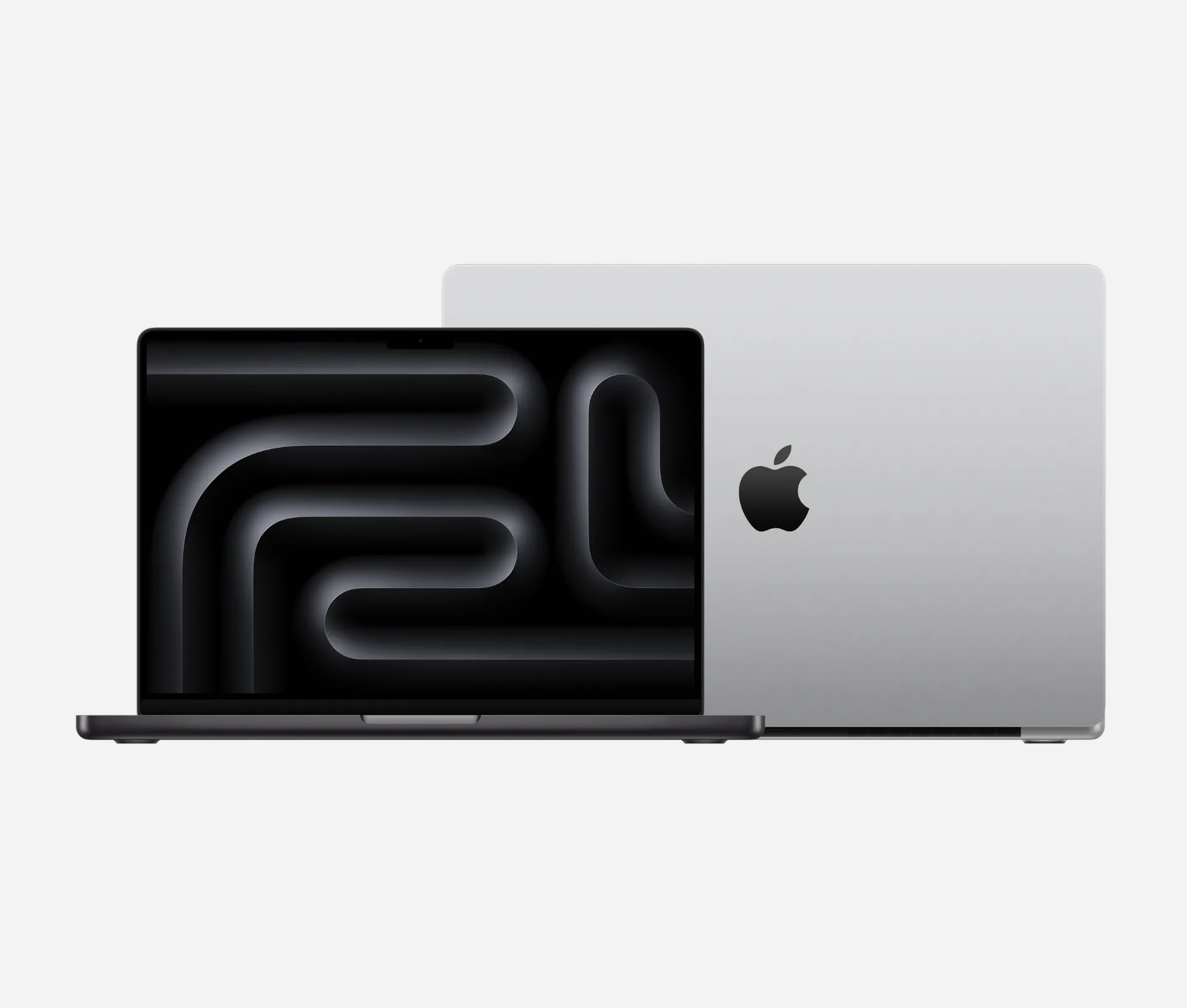
The MacBook Air and MacBook Pro are closer than they’ve ever been. The M5 Air handles everyday tasks, creative projects, and even demanding workloads without breaking a sweat. The Pro earns its premium through active cooling that prevents throttling under sustained load, a brighter Liquid Retina XDR display, and additional ports that matter in specific workflows.
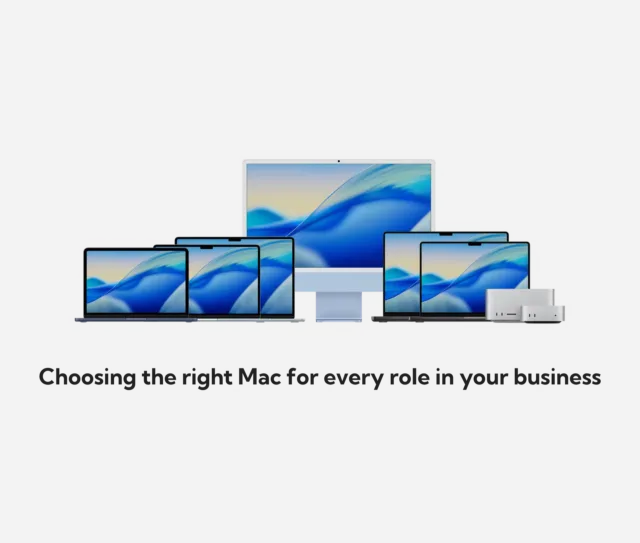
For most employees in most businesses, the Air is enough. For some, it genuinely isn’t. The mistake most businesses make is buying one device for everyone, whether that means speccing everyone up to a Pro when they don’t need it, or skimping on the Air for people whose work will quickly outpace it. This guide gives you a framework to make the right call, role by role.
The one difference that actually matters for business use
The spec gap between the MacBook Air M5 and MacBook Pro M5 covers display brightness, port selection, and chip configurations. All of those matter at the margins. The single difference that should drive most business procurement decisions is thermal management.
What thermal throttling is and when it happens
The MacBook Air has no fan. It’s fanless by design, which makes it whisper-quiet, lighter, and slightly thinner than the Pro. The trade-off is thermal management: when the chip runs at full capacity for an extended period, the Air throttles its own performance to prevent overheating, slowing the CPU down to manage heat without a fan to dissipate it.
For the vast majority of business tasks, the chip never reaches the threshold where throttling kicks in, so this rarely shows up in daily use. The problem only appears when someone runs a sustained high-intensity workload for an extended period: a long video export, a large software build, an hours-long machine learning task, or rendering a complex 3D scene.
Why the Air’s fanless design is a strength in most roles, and a limit in a few
For most employees, the Air’s fanless design is an unambiguous advantage. No fan noise during calls, longer battery life, a lighter bag. The chip is fast enough that throttling never triggers during email, video calls, spreadsheets, presentations, browser-based tools, or light creative work.
The limit appears in a specific subset of roles: those where the CPU or GPU runs at or near full capacity for hours at a time. Video editors running long exports, developers compiling large codebases, data analysts processing complex models, and 3D and CAD designers rendering large files are the roles where the Pro’s active cooling earns its price difference.
Procurement should hinge on whether a role runs sustained, full-capacity workloads for extended periods, which is a narrower group than job titles suggest.
Not sure which Mac fits which role?
Dr Logic can map your team to the right device and spec, before you place the order.
Roles that belong on a MacBook Air
The MacBook Air M5 handles everything listed below without performance compromise, starting at £1,299 for the 13-inch.
General office, admin, and operations roles
Email, calendar, video calls, browser-based tools, light document work, Microsoft 365, Slack, and the dozens of SaaS platforms that make up most modern office workflows: the Air handles all of this without ever approaching the threshold where throttling matters.
Account management and client-facing roles
Presentations, CRM, proposal tools, client calls, and document collaboration are all well within the Air’s capability. The 18-hour battery life is a genuine advantage for people who spend significant time in meetings, at client sites, or away from a desk. The 15-inch Air is worth considering for account managers who work frequently without an external monitor and benefit from more screen space.
Finance, HR, and people functions
Spreadsheet work, HR platforms, financial modelling at typical business scale, and document-heavy workflows all sit comfortably within the Air. Heavy Excel modelling with extremely large datasets occasionally triggers brief throttling during recalculations, but for the kind of financial modelling most SMB finance teams run, the Air is adequate throughout. If the finance team runs genuinely large actuarial or quantitative models, move them to the next section.
Leadership and management
For a business owner, CEO, or operations director whose device is primarily used for communication, strategy documents, calls, and occasional presentation work, the Air is the correct choice. The lighter weight and longer battery life better serve the mobile patterns of most leadership roles.
Roles that genuinely need a MacBook Pro
The entry MacBook Pro, 14-inch, M5 chip, starts at £1,999. That premium over the Air is justified for roles where sustained workloads are part of the daily job. Stepping up to an M5 Pro or M5 Max chip costs more within that same 14-inch model, and the 16-inch starts at £2,999 with no base M5 option at that size at all, 16-inch comes only with M5 Pro or M5 Max. Reserve those upper configurations for the most demanding professional creative or engineering roles.
Video editors and motion graphics
What decides it is whether someone runs sustained exports on large files. A social media manager cutting short-form content in CapCut or iMovie on a MacBook Air won’t notice a difference. A video editor running DaVinci Resolve or Final Cut Pro on 4K or 8K footage, working with multiple streams, colour grading, and exporting lengthy timelines, will. The Pro’s active cooling maintains consistent performance through a two-hour export where the Air would throttle.
The Pro’s HDMI port is also practically relevant here: a video editor who regularly connects to an external display or a client screen without an adapter benefits from having it built in. The SD card slot matters for editors who shoot on camera and ingest footage directly.
Software developers and engineers
Local development environments, build processes, containerised workloads, and running multiple services simultaneously create sustained CPU and memory pressure over long working sessions. A developer building a moderately complex project on an Air will eventually notice the chip pulling back during compilation. On the Pro, that workload runs at full capacity throughout. For engineering teams, the Pro is the standard configuration, and 24GB of RAM is the right starting spec.
Heavy data analysis and financial modelling
Beyond typical business-scale spreadsheet work, roles running Python or R for data analysis, building complex financial models with large datasets, or processing structured data at scale will benefit from the Pro’s consistent performance under load. If the work involves leaving a script or model running for an extended period, the Pro is the right device.
3D, CAD, and architecture
Sustained 3D rendering, CAD modelling, and architectural visualisation are the clearest use case for the M5 Pro and M5 Max chips’ additional GPU cores. For studios or practices where this work is a daily part of the role, stepping up to one of those chips is the appropriate configuration, that’s an additional cost on top of the £1,999 entry price, not something the entry-level M5 delivers.
Where the MacBook Neo fits in a mixed fleet
The MacBook Neo launched in March 2026 with an A18 Pro chip, now priced from £699. It’s fast, well-built, and capable of everything the majority of business users need.
Field, frontline, and seasonal roles
For businesses with field sales teams, reception and front-of-house roles, warehouse coordinators, or retail staff, the Neo is the right device. These roles need a reliable Mac for communication, basic admin, and task management. The Neo delivers all of that at a price point that makes the decision straightforward.
Shared devices and hot-desking
A device that’ll be used by multiple employees across shifts, or that lives in a meeting room or shared workspace, doesn’t warrant the full Air specification. The Neo handles this well, and its lower cost reduces the impact of the wear and higher replacement frequency that shared devices typically experience.
The cost argument for high-headcount teams
The Neo changes the maths for businesses with a large number of lower-intensity users. A 20-device procurement built entirely on Airs at £1,299 each comes to £25,980. Restructured as 10 Airs for knowledge workers and 10 Neos for lower-intensity roles, at £1,299 and £699 respectively, the same 20 devices come to £19,980, a saving of £6,000 on the procurement round, without reducing capability where it’s actually needed.
For businesses approaching a large procurement, mapping roles to the three-tier framework below before placing the order is worth doing properly. The Neo isn’t the right device for every role, but for the roles it fits, it fits well.
RAM: the decision most businesses get wrong
RAM is a purchase decision that can’t be revisited. Apple Silicon uses unified memory, and there’s no upgrade path after the device is configured and ordered. What you buy is what you keep for the life of the device.
16GB vs 24GB: where the threshold sits for business use
16GB is adequate for the vast majority of business users today. Email, video calls, Microsoft 365, browser-based tools, and most creative applications run well at 16GB. 24GB is the right configuration for developers running multiple services simultaneously, designers working with large files in Figma, Illustrator, or After Effects alongside other open applications, and any user running locally hosted AI tools that keep models in memory.
The device longevity question matters here. At year one, 16GB handles most workloads without constraint. At year three, as applications grow and workflows evolve, 24GB provides more headroom. For devices the business expects to keep beyond three years, configuring up to 24GB at purchase is the lower-cost decision over the device’s lifecycle compared to replacing a constrained device early.
When to configure up at point of purchase
Our recommendation is 16GB as the default for general business roles, 24GB for developers, heavy creative roles, data analysts, and any user the business expects to keep the device for four years or more. The Neo is currently available only at 8GB, which is appropriate for the lower-intensity roles it targets.
Building a procurement policy: a simple role-based framework
A clear policy, set centrally and applied consistently, eliminates the most common procurement error: individual managers negotiating for the highest-spec device for their team regardless of actual workload requirements.
| Role Type | Device | UK Price (From) |
|---|---|---|
| Lower-intensity: field, frontline, shared, seasonal | MacBook Neo | £699 |
| Sustained workload: video editors, developers, heavy data, 3D/CAD | MacBook Pro M5 | £1,999 |
| General business: office, admin, account management, finance, HR, leadership | MacBook Air M5 13-inch | £1,299 |
Roles that warrant the Air 15-inch rather than the 13-inch are those that primarily work without an external monitor and benefit from additional screen space: account managers, operations leads, and anyone with a significant document and reading workload.
How to set the policy so managers are not making individual exceptions
The policy needs a defined list of roles that qualify for each tier, agreed by IT and operations before procurement begins. Without that list, every procurement round becomes a negotiation, and the outcome is usually more Pros than the business needs. A clear role-based policy also makes budget planning more predictable: the finance team can model hardware spend accurately against headcount growth rather than against individual requests.
How DMS handles a mixed-device fleet
A mixed Neo, Air, and Pro fleet needs no extra complexity in your DMS (formerly MDM). Jamf, Addigy, and Apple Business all handle mixed device types without separate configurations. Device type doesn’t affect enrolment, policy application, or compliance reporting. The only thing worth checking is that role-specific applications are tested on the Neo’s A18 Pro chip as well as on Apple Silicon Macs; in practice, any application with a native macOS build runs correctly across all three.
All UK pricing confirmed from Apple’s UK store, 29 September 2026.
If you’re planning a Mac refresh or procurement round and want to build a device policy that matches the right hardware to the right roles, we can advise on the right configuration for your team.
Related articles
- Why Macs Cost More on Day One and Less Over Three Years: A Total Cost of Ownership Guide for UK Businesses
- Why Creative and Professional Services Firms Are Replacing Windows With Mac
- Switching Your Business from PC to Mac: What It Actually Takes (and Why Most Companies Get It Wrong)
FAQs
Which MacBook should I buy for a general office employee?
The MacBook Air M5, starting at £1,099 for the 13-inch. For office, admin, finance, HR, account management, and leadership roles, the Air handles all typical business workloads without any performance constraint. The fanless design is quieter, the battery life is longer, and the weight saving is noticeable for people who carry their laptop regularly. The MacBook Pro’s premium is not justified for these roles.
Where does the MacBook Neo fit in a business fleet?
The MacBook Neo at £599 is the right choice for lower-intensity roles including field sales, frontline staff, reception, shared devices, and seasonal workers. It is powered by the A18 Pro chip and handles communication, basic admin, and standard SaaS tools without issue. For businesses with a significant number of lower-intensity users, structuring a mixed procurement of Neo and Air devices reduces hardware spend meaningfully without sacrificing capability where it is needed.
How do I build a Mac procurement policy for a mixed team?
Define three tiers: MacBook Neo for lower-intensity and shared roles, MacBook Air as the default for general business users, and MacBook Pro for roles that run sustained high-CPU or high-GPU workloads. Set the role list centrally through IT or operations before procurement begins, rather than letting individual managers negotiate device upgrades. A Jamf or Addigy DMS handles mixed Neo, Air, and Pro fleets without any additional configuration complexity.