In the space of a week, a global Microsoft 365 outage took Outlook and Teams offline, a failed router grounded flights across the US, a fault at JPMorgan Chase spilled over into Zelle and other banks, and Apple Pay, iCloud and the App Store went down. On 17 November a classified NSA network joined the list. Plenty of people have looked at that run and concluded that AI must be behind it. The US Homeland Security Secretary hinted as much on Fox News, suggesting AI may have played a part in the bank outages.
The evidence published (so far) points elsewhere. Every affected organisation has blamed an internal fault, and US intelligence officials say they see no sign of an attack.
At the same time, two reports out this week show that AI-driven attacks are real and speeding up. Below we look at what caused the outages, what the new threat reports actually say, and what UK businesses should do about either.
What actually went wrong
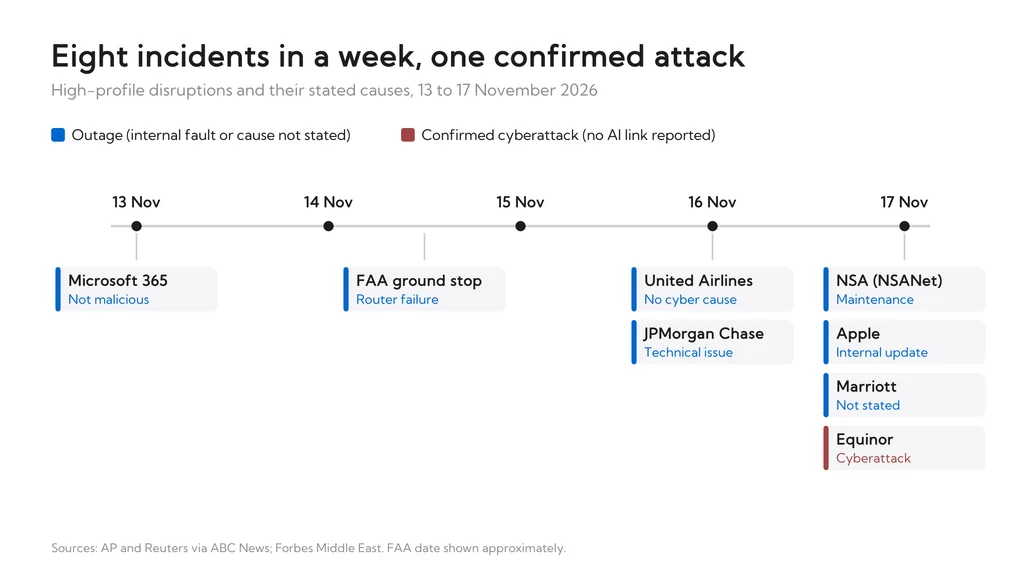
Of eight high-profile incidents in roughly a week, seven were outages and one was a cyberattack. None of the outages has been traced to an attacker, and the one attack (on Norwegian energy firm Equinor) hasn’t been linked to AI.
| Date | Organisation | What broke | Stated cause |
|---|---|---|---|
| 17 Nov | NSA | NSANet, the agency’s classified internal network | Scheduled routine maintenance; no evidence of an attack |
| 17 Nov | Apple | App Store, Apple Music, AppleCare on Device, iCloud sign-in, Apple Pay; later Schoolwork and Apple School Manager | An internal update; Apple ruled out a cyberattack |
| 17 Nov | Marriott | Reservations and check-ins | Not stated |
| 17 Nov | Equinor | Some IT systems | A detected cyberattack; no AI link reported |
| 16 Nov | United Airlines | A 90-minute-plus system outage that delayed departures | No sign of a cybersecurity cause |
| 16 Nov | JPMorgan Chase, plus Zelle and other banks | Online banking access | A technical issue, not a cyberattack |
| Mid-Nov | FAA | A network router failure that triggered a nationwide ground stop | Root cause still undetermined; the FAA calls AI speculation unfounded |
| 13 Nov | Microsoft 365 | Outlook, Teams and Copilot, worldwide | Not malicious and not related to AI agents |
For what it’s worth, the explanation from Washington has been consistent. Jay Clayton, the US Director of National Intelligence, said organisations are upgrading and patching systems at the same time, and some of those systems aren’t coming back up as expected, particularly where one has to hand over to another. He told reporters that investigators weren’t treating any of it as a cyber incident.
The recent FAA total ground stop is the case to watch. Transportation Secretary Sean Duffy admitted there was no clear explanation for how one router failure could halt flights across the country. Whatever the root cause turns out to be, a single device capable of grounding a nation’s air traffic is a resilience problem.
Google’s first fully automated AI attack
On 16 November, Google’s Threat Intelligence Group and its Mandiant incident response team reported what they believe is the first cyberattack run from start to finish by AI, with no human involved at any stage. Politico Europe broke the story, and CyberScoop and others have since reported the detail.
The system, which Google’s researchers named exploit_agent, links several AI agents running on a mix of frontier and locally hosted language models. It watches widely used software for new security patches and compares the code before and after each fix to work out which flaw was closed. It then writes an exploit for that flaw and launches it against websites that haven’t installed the update yet.
Investigators also found scripts for password guessing, internal reconnaissance and planting webshells (hidden backdoors on a web server), plus one that deleted webshells left behind by rival attackers. Google found the whole toolkit on a staging server the attackers had left unsecured.
Who was behind it
The “Russian speakers” in the headlines rest on fairly thin evidence. Google hasn’t named a group or a country; the attribution comes from Russian-language comments in the code. The victims were French websites in media, entertainment and education, and nothing in the report connects this campaign to the outages in the US.
Why security teams are paying attention
What makes exploit_agent dangerous is speed. Every published patch becomes a working attack, often before the businesses that need the patch have installed it, so the safe window between a fix appearing and a fix being applied keeps shrinking.
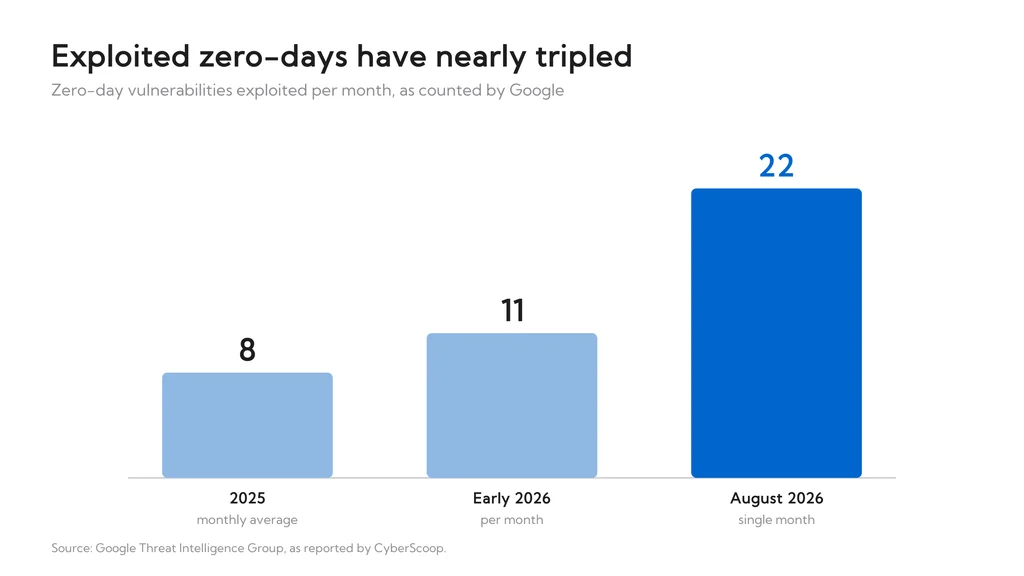
Google’s wider figures point the same way. It counted 22 exploited zero-days (flaws unknown to the vendor when attacked) in August alone, up from 11 a month earlier in 2026 and an average of eight a month in 2025. When two PHP vulnerabilities were patched on 21 October, hundreds of claimed exploits appeared within days. Most didn’t work and were probably AI-generated, but the volume shows how quickly attackers now move.
Defenders do have one advantage for now. Google notes that these tools are loud: they move fast and leave obvious traces, which gives security teams something to detect and block. The report also mentions two open-source attack frameworks, CAIRN and PentAGI, used against a US aerospace company and organisations in Asia, and a China-linked group building its own automated toolkit.
The FBI’s warning about ARTEX
Three days before Google’s report, on 13 November, the FBI issued a flash advisory about a tool called ARTEX. Criminals have been using it to automate attacks on organisations around the world since at least August.
ARTEX began life as an open-source security testing platform, the sort of thing IT teams run against their own systems to find weak spots. Attackers repurposed it to scan for vulnerabilities, break into networks and steal data. In some cases they went from first foothold to administrator-level access in under three hours.
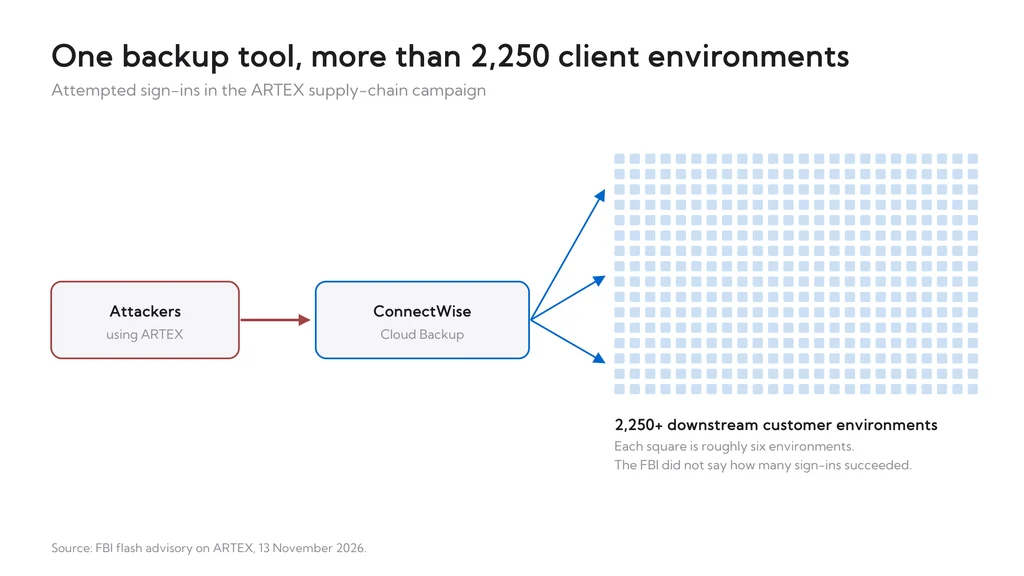
The advisory lists victims in finance, government, defence, energy, healthcare, manufacturing, telecoms, legal services and more. It highlights a breach at a South Korean financial institution that reportedly exposed personal data on around 67,000 people. It also describes a supply-chain attack on customers of ConnectWise Cloud Backup, which led to attempted sign-ins to more than 2,250 downstream customer environments. The FBI didn’t say how many of those attempts succeeded.
That second campaign should interest any business that uses a managed IT provider. Backup and remote-management tools give access to many client networks at once, so compromising one is worth far more to an attacker than breaking into a single company.
The developer pulled ARTEX’s public code after its misuse came to light in October, but copies and modified versions are still in circulation. The FBI’s recommendations are practical: review internet-facing systems, restrict access to admin tools, and watch for unusual sign-ins and data transfers. As with Google’s report, there’s nothing tying ARTEX to the recent outages.
Outage or attack?
From the outside, an outage and an attack look the same: the service stops working. That’s why a cluster of failures can feel like a coordinated campaign even when each one has a mundane cause.
Several things make outages bunch together. Organisations tend to upgrade and patch in waves, and that’s the official explanation for this month’s run: updates and maintenance at Apple and the NSA, and failed handoffs between old and new systems elsewhere. Huge numbers of businesses also depend on the same few platforms, so when Microsoft 365 or iCloud has a bad morning, millions of people notice at once. Hidden single points of failure, like the router behind the FAA ground stop, let small faults have outsized effects. And once a few incidents make the news, every new one gets reported as part of the same story.
Could AI be involved indirectly?
There’s one plausible connection, though it’s our reading rather than anything officials have said. If AI tools can turn a patch into an attack within days, every organisation is under pressure to patch and upgrade faster, and rushed changes to complex systems are a classic cause of outages. On that view, AI’s role would be indirect, squeezing the time organisations have to change their systems safely.
How much weight to give official statements
Early statements come within hours, before investigations finish, and the FAA still hasn’t found its root cause, so some caution is fair. Even so, nobody has published evidence that AI or any attacker caused these outages, and the official accounts hang together.
Nick Andersen, acting director of the US Cybersecurity and Infrastructure Security Agency (CISA), made a point on 17 November that’s worth repeating. People care about outcomes, he said, and a bad patch, a failed upgrade and a cyberattack all call for systems designed to withstand disruption. He added that online talk of an AI “vulnpocalypse” risks pushing basic resilience work down the agenda. CISA found no sign of malicious activity behind the FAA ground stop.
What AI changes for attackers
Both reports describe attackers exploiting familiar weaknesses: unpatched software, exposed admin tools and weak sign-in security. AI lets them do it faster, at greater scale and with less skill.
| Area | What AI changes | What stays the same |
|---|---|---|
| Speed | Patches become working exploits within days; ARTEX reached admin access in under three hours | Attackers still need an unpatched or misconfigured system to get in |
| Skill | Google describes the barrier to entry as low | The flaws being exploited mostly have fixes available |
| Scale | One operator can target thousands of sites around the clock | Patching, MFA and limited admin rights block much of it |
| Zero-days | 22 exploited in August 2026, against an average of eight a month in 2025 | Known flaws and stolen credentials remain common ways in |
| Stealth | Current AI tools are noisy and leave clear traces | Good monitoring still catches intruders |
| Tools | Legitimate testing tools are being repurposed for attacks | Defenders can run the same kind of tools against their own systems |
The last row works in defenders’ favour. Software that can read a patch and build an exploit can also help security teams find and fix weaknesses before attackers do. The businesses most at risk are the ones still patching and monitoring at last year’s pace.
So anyone expecting AI-driven attacks to increase is probably right; Google says it’s highly likely these frameworks will keep being used against organisations worldwide. Blaming AI for this month’s outages is a bigger leap, and nothing published so far supports it.
What this means for UK businesses running Apple
For a UK SME, the practical risks right now have little to do with Russian-speaking AI agents. They come from depending on a few cloud platforms, patching slowly, and trusting suppliers whose security you can’t see.
Cloud dependence
The 17 November Apple incident took down iCloud sign-in, Apple Pay and the App Store, along with Schoolwork and Apple School Manager for schools. Apple blamed an internal update. For a business running Macs and iPhones, device sign-in, app deployment and file sync all rely on Apple’s cloud services. If your team can’t work for half a day when iCloud is down, that’s worth fixing regardless of the cause. The same goes for Microsoft 365, which many Mac-based studios use for email and Teams, and which went down worldwide on 13 November.
Patching Macs and iPhones
AI-driven exploitation targets the gap between a fix being released and a fix being installed. That gap exists on macOS, iOS and the apps running on them as much as on Windows. A Mac that’s three updates behind is precisely what a tool like exploit_agent is built to find.
Websites
Google’s campaign hit media, entertainment and education websites. Many UK creative agencies run their own site and client sites on popular PHP-based platforms, and the October PHP flaws showed how quickly exploits now follow a patch. An outdated plugin is a much bigger risk than it was a year ago.
Your IT provider
The ConnectWise campaign is the detail most relevant to businesses that outsource IT. Attackers target the tools providers use because one breach can reach hundreds or thousands of client networks. It’s reasonable to ask your provider how they secure their remote-access and backup tools, and how quickly they’d know if one were compromised.
What to do now
Nothing on this list is new. AI simply makes skipping any of it more expensive, and most of it comes straight from the FBI’s advisory and CISA’s comments.
- Shorten your patch window. Use your device management platform to push macOS, iOS and app updates automatically with firm deadlines, and treat critical security fixes as a matter of days.
- Map what faces the internet. List every website, plugin, remote-access tool and admin portal you expose, remove what you don’t need, and keep the rest current.
- Tighten admin access. Turn on multi-factor authentication for every admin account, limit admin rights to the people who need them, and restrict who can use remote-management tools.
- Monitor sign-ins and data movement. Alerts for logins from unexpected locations or unusually large downloads will catch a lot of noisy, automated activity.
- Plan for a platform outage. Agree an alternative way to communicate, make sure key files are available offline, and write down who does what when iCloud or Microsoft 365 goes down.
- Test and protect your backups. Restore something real at least once a quarter, and keep backups out of reach of the accounts an attacker would target first.
- Question your IT provider. Ask how they secure their own tools, how quickly they’d detect a compromise, and how they’d tell you.
- Brief your team. AI makes phishing more convincing, so a refresher on checking unexpected requests for payments or logins is worth the time.
- Use Cyber Essentials as a baseline. The UK government-backed scheme covers most of the controls above and gives you an independent check that they’re in place.
So, is AI to blame?
On the evidence available today, no. Every organisation hit by this month’s outages has pointed to updates, maintenance or technical faults, and neither US intelligence nor CISA has found signs of an attack. Rushed upgrades, fragile links between systems and reliance on a handful of platforms explain the pattern well enough.
The worry behind the AI theory is still reasonable. This week Google documented an intrusion run entirely by machines, and the FBI warned about a repurposed testing tool already in criminal hands. Those threats are growing quickly, even if they had nothing to do with Outlook or iCloud going down.
Either way, the defence is the same. Whether the next disruption is a bad update or an automated attack working through last night’s patch notes, the businesses that cope best will be the ones that patch quickly and know what to do when a cloud service goes quiet.
Related articles
- Microsoft says three problems lined up to take Outlook down for almost a day
- PHP has patched two critical flaws found with AI, so check who’s updating your websites
- Types of vulnerability in cybersecurity, explained for business owners
FAQs
Was AI behind the recent outages at Microsoft, Apple and the NSA?
There’s no evidence of that so far. Each organisation blamed an internal fault such as an update, routine maintenance or a technical issue, and neither US intelligence nor CISA has found signs of an attack. The FAA is still investigating the root cause of its nationwide ground stop.
What was the first fully automated AI cyberattack?
In November 2026, Google reported that attackers had used a system called exploit_agent to run an attack from start to finish with no human involved. It reads newly published security patches, works out which flaw each one fixed, writes an exploit and attacks websites that haven’t installed the update. The victims were French media, entertainment and education websites.
What is ARTEX?
ARTEX is an open-source security testing tool that criminals have repurposed to automate attacks. The FBI warned on 13 November 2026 that it has been in use since at least August, sometimes reaching administrator access within three hours. One campaign targeted ConnectWise Cloud Backup customers, with attempted sign-ins to more than 2,250 downstream environments.
Are AI-driven cyberattacks going to get worse?
Most likely, yes. Google counted 22 exploited zero-days in August 2026, against an average of eight a month in 2025, and expects automated attack frameworks to keep being used worldwide. For now these tools are noisy, which gives defenders a better chance of spotting them.