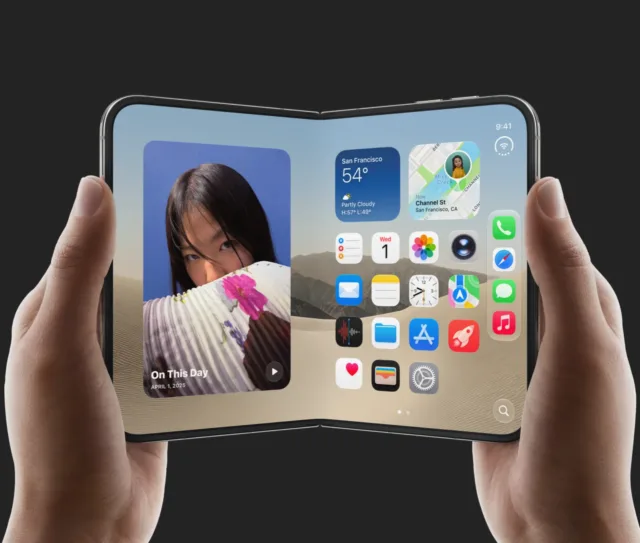
Every foldable phone since Samsung’s first has faced the same question: does the fold survive daily use, or does it become the first thing that breaks? Apple confirmed its answer at its September event with iPhone Duo, its first foldable iPhone, and built the case for durability directly into the announcement rather than leaving it to third-party teardowns.
The durability case, point by point
iPhone Duo is built from grade 5 titanium, with an IP68 dust and water resistance rating, matching Apple’s standard flagship devices. Ceramic Shield protects the back, and Ceramic Shield 2 on the front offers three times better scratch resistance than the previous generation. The hinge itself is built from more than 100 components, engineered to support the display’s centre and hold it flat when open, with internal support ribs reinforcing the structure.
Durability Angle: an IP68 rating on a folding phone is the detail that speaks most directly to the concern the entire category has faced, that a hinge and a fold are inherently a weak point. Matching standard flagship water resistance, and doing so ahead of the equivalent rating on Samsung’s foldable, is a concrete answer rather than a marketing claim. Real-world hinge performance under sustained daily use will still only become clear with time in the field.
What’s genuinely new, not just expected
Beyond durability, several confirmed details weren’t part of the pre-event rumour picture:
- Touch ID, not Face ID. Authentication runs through Touch ID built into the side button, alongside the option to unlock via Apple Watch, a genuine departure from every other current iPhone.
- eSIM-only worldwide, including the UK, with no physical SIM tray anywhere, unlike the iPhone 18 Pro range, which keeps a physical SIM in some markets.
- Apple Pencil support is delayed. The USB-C Apple Pencil will work with iPhone Duo, but only “later this year” via a software update, not at launch.
- Displays: a 7.6-inch inner display, 50% larger than the iPhone 18 Pro Max’s, and a 5.4-inch outer display giving 90% of the 18 Pro’s screen area, both with a nano-texture finish designed to reduce glare and minimise visible creasing.
Why the delayed details matter for a rollout
Powered by the same A20 Pro chip as iPhone 18 Pro, iPhone Duo delivers up to 35% better sustained performance than the iPhone 17 Pro, with battery life reaching up to 31 hours on the inner display or 44 hours on the outer. UK pricing starts at £1,999, rising to £3,199 at 2TB, with pre-orders from 16 October and availability from 23 October, a full month after the rest of the lineup.
Rollout Angle: the delayed Pencil support and eSIM-only design are both worth building into any deployment timeline rather than assuming day-one parity with a standard iPhone. A device shape this new also isn’t compatible with cases, mounts or docks built for a standard iPhone, worth treating as a separate procurement line rather than an afterthought.
Rolling our iPhone Duo to your team?
eSIM-only setup, delayed Pencil support and new accessories all need planning. We manage company iPhones and iPads for UK businesses, from enrolment to day-to-day support.
The Short Version: Apple’s durability case is concrete, titanium, IP68, Ceramic Shield, and a heavily reinforced hinge. What the pre-event rumours didn’t cover is that it’s Touch ID rather than Face ID, eSIM-only everywhere including the UK, and that Apple Pencil support won’t arrive until later this year. Pricing runs £1,999 to £3,199, on sale a month after the rest of the range.
Read more September Announcement coverage: this piece is part of our ongoing breakdown of Apple’s September 2026 event. Explore the announcements →